Knight Capital: The 45-Minute, $460 Million Deployment
On August 1, 2012, Knight Capital — one of the biggest stock-trading firms in America — pushed a routine software update to eight servers. One server was missed. In the first 45 minutes of trading, that single server fired off more than 4 million unintended trades, built up roughly $6.7 billion in positions nobody wanted, and lost over $460 million. This is the documented story of how it happened, how the firm survived, and the controls it forced on the whole industry.
The short answer
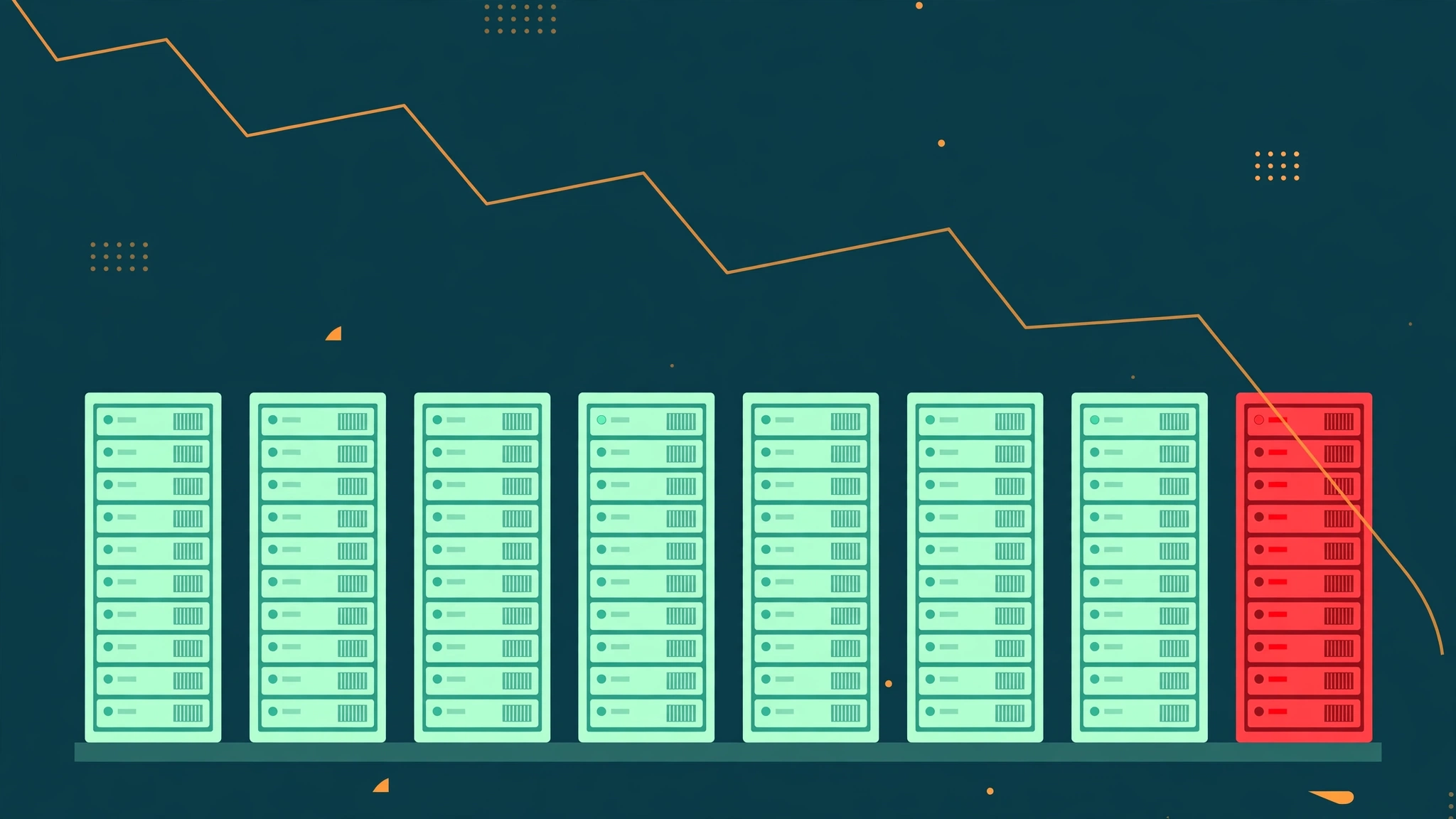
On the morning of August 1, 2012, Knight Capital, one of the largest stock-trading firms in the United States, opened the market with a software bug that had been installed by hand over the previous few days. New code had been copied to seven of its eight order-routing servers — one server was missed, and nobody checked. That server still contained a retired function called "Power Peg," and the new software reused an on/off switch (a "flag") that woke the old function up. Worse, a safety counter inside the old function had been broken years earlier, so once it started sending orders, it never stopped. In about 45 minutes the firm executed more than 4 million unintended trades, piled up roughly $6.7 billion in unwanted stock positions, and lost over $460 million. Knight survived only because investors injected $400 million five days later — a rescue that cost its original shareholders most of the company.
The company: what Knight Capital did
Knight Capital was a market maker — a firm that stands ready to buy and sell stocks all day long, quoting prices and taking the other side of other people's trades, so that ordinary investors can trade instantly whenever they want. If you bought shares through a retail broker in 2012, there was a good chance Knight was on the other side of your trade without you ever knowing its name.
It was big. According to the U.S. Securities and Exchange Commission (SEC), Knight's trading — its own plus its customers' — generally represented about 10 percent of all trading in listed U.S. stocks in 2011 and 2012, and it was also a designated market maker on the New York Stock Exchange (NYSE), responsible for overseeing trading in hundreds of listed companies. Its principal operations were in Jersey City, New Jersey.
The engine at the center of this story is called SMARS, Knight's automated order router. A router is the traffic cop of a trading firm: it receives a big customer instruction — a parent order, such as "buy 50,000 shares of IBM" — and, as needed, breaks it into smaller child orders that it sends out to exchanges and other trading venues for execution. SMARS was high-speed and algorithmic (it made these decisions by formula, with no human in the loop), and by itself accounted for roughly 1 percent or more of all trading in listed U.S. stocks. Why this matters: when a system that touches a tenth of the market breaks, it does not break quietly.
The problem: a routine deployment
The trigger was not an attack, a market crash, or a reckless bet. It was a deployment — the ordinary job of installing new software on production servers.
On August 1, 2012, the NYSE was launching a new Retail Liquidity Program (RLP), a program designed to give everyday ("retail") investors slightly better prices. Knight wanted its customers in the program on day one, so its engineers wrote new code for SMARS and, beginning July 27, 2012, installed it in stages over successive days across the eight servers that ran the router.
Three quiet facts made this routine job dangerous:
First, the new code reused an old switch. Years earlier, SMARS had contained a function called Power Peg. Knight had stopped using Power Peg in 2003, but the code was never deleted — it sat dormant on the production servers. The new RLP code was intended to replace that dead code, and it repurposed a flag — think of a flag as a labeled on/off switch in the software — that had originally been used to activate Power Peg. Set the flag to "yes," and the machine would run whatever code sat behind that switch.
Second, the dead code's safety counter had been broken in 2005. When Power Peg used to run, it had a cumulative quantity check: it counted how many shares of a parent order had already been executed, and stopped sending child orders once the parent was full. In 2005, Knight moved that counting function to an earlier point in the SMARS code sequence — which quietly disabled it inside Power Peg. Nobody retested Power Peg after the move, because nobody expected to use it again. The result was a loaded trap: if Power Peg ever woke up, it would send child orders forever, with no memory of what had already been filled.
Third, the deployment itself had no safety net. Per the SEC's findings, one technician copied the new code to the servers and simply missed one of the eight. Knight had no written deployment procedures for SMARS, and no rule requiring a second technician to verify the work. On the missed server, the old Power Peg code remained in place — and the repurposed flag now pointed straight at it.
An analogy: imagine an eight-piece band where one musician is handed last year's sheet music, and nobody does a sound check. The concert starts, the conductor raises the baton — and one instrument plays a completely different song, at full volume, with no way to signal it to stop.
What this shows: the reused flag was a shared switch. What it switched on depended on which code was still installed behind it — new code on seven servers, retired code on the eighth.
What happened on August 1, 2012
All times are Eastern, as documented in the SEC's order and contemporaneous reporting.
July 27–31 — The new RLP code is deployed to the SMARS servers in stages. One of the eight servers is missed. No verification catches it.
~8:01 a.m., August 1 — Knight begins processing some RLP-eligible orders designated for pre-market trading. An internal system starts generating automated emails called "BNET rejects." They reference SMARS and name the error: "Power Peg disabled." Before the 9:30 a.m. market open, the system sends 97 of these messages to a group of Knight personnel. But the messages were not designed as alerts, staff generally did not review them, and nobody acts on them. The one clear warning, an hour and a half early, goes unread.
9:30 a.m. — The market opens. RLP-eligible customer orders flow in and are spread across all eight servers. On seven, the new code handles them correctly. On the eighth, orders arrive carrying the repurposed flag — and the flag wakes Power Peg. Because its cumulative-quantity counter was broken in 2005, the server cannot tell that parent orders are already filled. (Another part of Knight's platform did know the orders were filled, the SEC found — but that information was never communicated to SMARS.) The server begins firing child orders in rapid sequence, for each incoming parent order, without limit.
9:30–~10:15 a.m. — The scale explodes. Just 212 small retail parent orders are processed by the defective code, and they generate millions of child orders and over 4 million executions in 154 stocks, totaling more than 397 million shares, in approximately 45 minutes. Knight is now involuntarily long (it owns) about $3.5 billion of stock across 80 companies and short about $3.15 billion across 74 companies (a short position means it had sold shares it did not own and would have to buy them back later). Its buying and selling is also moving the wider market: in 75 stocks, Knight's executions made up more than 20 percent of all trading and helped push prices by more than 5 percent; in 37 of those, prices moved more than 10 percent and Knight was more than half of all volume.
What this shows: the 45 minutes, compressed. One server's retired code turned 212 small parent orders into more than 4 million executions — and because its stop-counter was broken, it never let up.
During the incident — Knight's technology staff scramble to find the cause in a live market. The firm has monitoring — a tool called PMON showed positions piling up in a catch-all account (the "33 Account") — but PMON only displayed information for humans; it generated no automated alerts and was not connected to anything that could stop orders. Knight also had no procedure telling staff when to disconnect a malfunctioning system. In one attempt to fix the problem, staff uninstalled the new RLP code from the seven correctly updated servers — which made things worse, because the old Power Peg code still present on those servers could now be triggered by new parent orders too.
Later on August 1 — The erroneous order flow stops after roughly 45 minutes. NYSE announces it is reviewing trades executed between 9:30 and 10:15 a.m. in 148 symbols under its "clearly erroneous" rules. Knight's shares plunge.
The damage
Start with the rescue that didn't come. Many assumed the exchanges would simply cancel the bad trades. They mostly didn't. The clearly-erroneous rules only allow cancelling trades far from the market price, and NYSE ultimately cancelled trades in just six stocks — the ones whose prices had moved 30 percent or more. Every other trade stood. Knight owned the problem.
The bill, per the SEC's order, was a loss of over $460 million on the unwanted positions. (Knight's own statement at the time put the realized pre-tax loss from exiting the positions at approximately $440 million; the SEC's figure is the higher, final one.) For scale: the firm lost that money in about 45 minutes — on the order of $10 million a minute — and the loss blew a hole in its capital base, creating what the SEC called "significant net capital problems." Net capital is the financial cushion a broker-dealer is legally required to keep; damage it badly enough and the firm cannot legally keep operating.
Knight's share price collapsed, losing well over half its value within two days. And because many of the millions of unintended sell orders were technically short sales, Knight had also mismarked them and failed to arrange the required share borrowings — violations of Regulation SHO that the SEC added to its case.
Then came the regulator. On October 16, 2013, the SEC issued its administrative order: Knight had violated the Market Access Rule (Rule 15c3-5) — the rule requiring brokers to maintain risk controls over their access to the markets. It was the first enforcement action ever brought under that rule. Knight, without admitting or denying the findings, consented to a censure, a cease-and-desist order, a $12 million penalty, and a requirement to hire an independent consultant to comprehensively review its controls.
How they recovered
Step one: get out of the positions. Knight exited its accidental portfolio within days. It announced on August 2 that it had traded out of its entire erroneous position, crystallizing the ~$440 million pre-tax loss, and contemporaneous reporting (Bloomberg, carried widely at the time) reported that Goldman Sachs bought the bulk of the unwanted securities from Knight in a negotiated transaction at a discount — the financial equivalent of paying a tow truck whatever it costs because your car is blocking the highway. Knight also confirmed to clients that they were not negatively affected by the erroneous orders, and it removed the offending software from its systems.
Step two: the exchange pulled its duties. Because Knight was a designated market maker, NYSE temporarily transferred responsibility for its 524 NYSE-listed and 156 NYSE MKT-listed securities to rival GETCO's market-making unit on August 6; Knight resumed those duties on August 13 once its financing was in place.
Step three: the $400 million rescue. On August 6, 2012 — five days after the incident — Knight closed a rescue financing documented in its SEC filings: a group of investors including Jefferies, Blackstone, GETCO, TD Ameritrade, Stephens, and Stifel bought $400 million of convertible preferred stock (a loan-like investment that converts into shares). The price of survival was steep: on conversion, the rescuers would own roughly 73 percent of the company, at an effective price of about $1.50 per share. The original shareholders kept the company alive but lost most of it.
Step four: the merger. GETCO, one of the rescuers, ultimately combined with Knight. The merger agreement was signed on December 19, 2012, valuing Knight at $3.75 per share (about $1.4 billion in total), and the deal closed on July 1, 2013, combining the two firms into a new company, KCG Holdings, Inc. Knight the independent firm — a decade-defining market maker — had ceased to exist eleven months after a 45-minute software error.
The fix: technology and controls that came out of it
The SEC's order reads, in hindsight, like a checklist of controls that are now considered basic in trading technology. Knight's failures — and the remedies the order imposed — map directly onto them:
Deployment verification. The proximate cause was a hand deployment with no check. The SEC said it plainly: "a written procedure requiring a simple double-check of the deployment of the RLP code could have identified that a server had been missed and averted the events of August 1." Modern practice — automated deployment pipelines, per-server version verification, and configuration-drift detection (automatically spotting any server whose software or settings differ from its peers) — exists precisely so that "seven out of eight" is caught by a machine, not discovered by the market.
Dead-code discipline. Power Peg survived nine years past its retirement, and its broken counter survived seven. The order faulted Knight for having no written protocol for accessing unused code on production servers — including retesting such code after touching it. The lesson the industry took: unused code in production is not harmless; either delete it or treat it as live, because a repurposed flag can make it live.
Pre-trade kill switches and capital limits that actually bite. Knight's position limits were not linked to automated controls: its monitoring account had a $2 million gross limit that nothing enforced, and PMON could show humans a disaster without stopping it. The order required Knight's independent consultant to specifically review "firm-wide capital thresholds and the linkage, on an automated, pre-trade basis, of such thresholds to the entry of orders." In plain terms: if exposure crosses the line, the system itself stops sending orders — no meeting required. A related gap: Knight had no control comparing orders leaving SMARS with orders that entered it. An input-versus-output sanity check at the router would have flagged millions of child orders against 212 parent orders within seconds.
Alerts that are actually alerts. Ninety-seven warning emails arrived before the open and changed nothing, because they weren't wired into any monitoring or escalation process. The fix is not more messages; it's routing real error signals into paging and incident-response procedures — which Knight also lacked, leaving staff to improvise mid-incident (including the uninstall decision that spread the fault to seven more servers).
Independent review. As part of the settlement, Knight had to retain an independent consultant to review its software development lifecycle, deployment processes, order routers, capital thresholds, and incident-response protocols — and the SEC noted Knight's own pre-incident compliance reviews had mostly inventoried existing controls instead of asking what could malfunction. That question — "what happens if this component goes wrong, and what stops it?" — is the one the SEC's enforcement chief said Knight failed to ask, and it became the industry's homework.
What this means for you
Enterprise network engineers
Your version of SMARS is the load balancer pair, the firewall cluster, the core switch stack — systems where "I updated all of them" is asserted from memory. Knight's failure is configuration drift with a dollar sign: one node silently running different code than its peers. The defenses are the same at any scale: automate deployments so a human never hand-copies to eight boxes, verify version and config on every node after a change, and alert on drift continuously, not at the next audit. And when an incident starts, have the runbook written before you need it — Knight's improvised "fix" (uninstalling the good code) spread the fault from one server to eight.
Hyperscaler engineers
You deploy to thousands of nodes, which removes the "missed one server" problem and replaces it with subtler ones: partial rollouts, canary fleets running mixed versions, and feature flags whose meaning changes over time. Knight's repurposed flag is your warning — a flag is a contract between the code that sets it and every code path that reads it, including code paths everyone forgot exist. Audit flag consumers, delete dead code paths (or prove they are unreachable), and treat "this path hasn't run in years" as a risk finding, not a comfort. Knight also shows why blast-radius limits matter: staged rollouts only protect you if the stages are actually verified before proceeding.
HFT / low-latency engineers
This is your industry's founding cautionary tale, and the Market Access Rule (15c3-5) controls it produced are your daily reality: pre-trade risk checks, firm-wide capital thresholds wired directly into order entry, and kill switches that a human — or the system itself — can hit in seconds. The details that should sting: Knight's risk tool was post-trade and human-read (at microsecond-to-minute speeds, a dashboard nobody can act on is decoration), its limits lived in an account nothing enforced, and there was no output-versus-input check at the router — the cheapest possible sanity test. If your kill switch has never been tested in anger, if your capital check isn't in the order path itself, or if a single host can run different code from its siblings, you are running Knight's architecture with better luck.
Try it yourself
Knight's core failure was one server out of eight running different code from the rest — configuration drift. You can practice spotting exactly that class of problem with Packet Path's free Network Config Verifier: paste configs from two devices side by side and it flags mismatches — duplicate IPs, OSPF and BGP inconsistencies, reachability problems, dead rules. The habit it builds is the one that would have saved Knight: never assume the fleet matches. Compare it, every time.
Sources
Primary source — U.S. Securities and Exchange Commission, In the Matter of Knight Capital Americas LLC, Securities Exchange Act Release No. 70694, Administrative Proceeding File No. 3-15570 (October 16, 2013). All incident mechanics, figures, and control findings are taken from this order: https://www.sec.gov/newsroom/press-releases/2013-222 (SEC press release summarizing the order) and the full order text as filed as an exhibit to KCG Holdings' SEC filings.
SEC Form 8-K, Knight Capital Group, Inc. (August 6, 2012) — the $400 million convertible preferred rescue, investor group, and ~73% as-converted stake: https://www.sec.gov/Archives/edgar/data/1060749/000119312512338098/d392396d8k.htm
SEC Form 8-K, KCG Holdings, Inc. (July 1, 2013) — merger agreement dated December 19, 2012, $3.75-per-share consideration, and July 1, 2013 closing forming KCG Holdings.
Contemporaneous reporting: The Trade News (August 2 and August 8, 2012) on NYSE's review of 148 symbols, cancellation of trades in six stocks, and the temporary transfer and restoration of Knight's designated-market-maker duties; Knight Capital's August 2, 2012 statement (quoted in The Global Treasurer, August 3, 2012) that it had traded out of its erroneous position at a realized pre-tax loss of approximately $440 million; Bloomberg reporting (carried by TheStreet and others, August 6, 2012) on Goldman Sachs purchasing the unwanted securities and the rescue terms.
- One server out of eight missed a deployment — and there was no second-person check and no automated verification to catch it.
- Dead code is a live risk: a flag repurposed for new software reactivated a function retired in 2003 whose safety counter had been silently broken since 2005.
- Knight had monitoring but no kill switch: nothing compared orders leaving its router to orders entering it, and nothing stopped trading when capital limits were breached.
- The warnings existed — 97 automated error emails arrived before the market opened — but they were not wired into any alerting process, so nobody acted on them.