Oscillator Types Explained: TCXO vs OCXO vs CSAC vs Rubidium
Every clock that has to survive on its own is really an oscillator with a support act. A TCXO corrects a crystal for temperature, an OCXO hides the crystal in an oven, a CSAC shrinks an atomic clock onto a chip, and a rubidium standard locks a crystal to an atom. The four differ by about thirty thousand times in how much time they lose in a day — and the step you buy is decided by three plain trades: how long you must hold, how much power you can spend, and what a wrong timestamp costs you.
The short answer
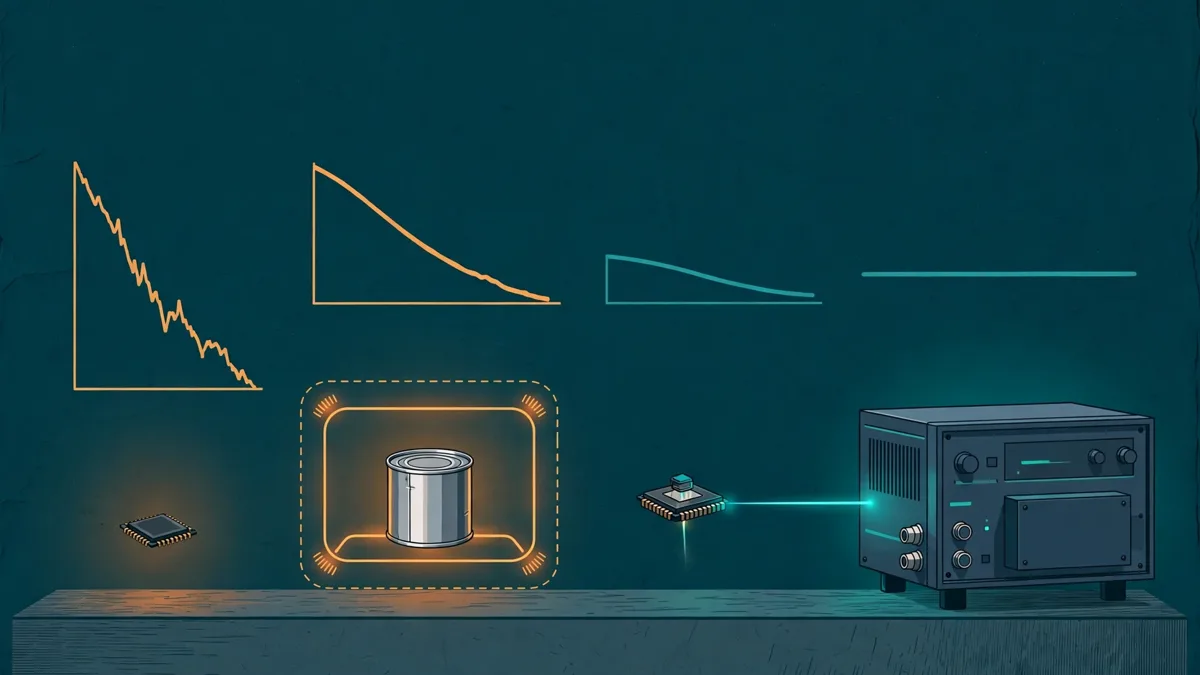
What is the difference between a TCXO, an OCXO, a CSAC and a rubidium oscillator? They are four ways of keeping time when nothing is checking. A TCXO is a quartz crystal with electronic temperature correction. An OCXO is the same crystal kept at a constant temperature inside a tiny oven — the best quartz can do. A CSAC (chip-scale atomic clock) and a rubidium oscillator are atomic clocks: they steer a crystal against the fixed vibration of atoms, so they barely age at all. Over 24 hours alone, a typical TCXO drifts about 8.64 milliseconds, a standard OCXO about 8.64 microseconds, a CSAC typically about 864 nanoseconds, and a rubidium about 259 nanoseconds. The companion article on PTP holdover explains what holdover is and why the reference disappears; this one is about the hardware that decides how long you survive it.
Think of four wristwatches left in a drawer for a day. The first is a decent quartz watch: excellent by everyday standards, minutes out over a year. The second is the same watch kept in a climate-controlled safe — temperature, its biggest enemy, simply stops changing. The third and fourth stop trusting springs and crystals altogether and count something in nature that never changes its rate: the vibration of atoms. Each step costs more, in money or power or size. Each step buys roughly a thousand times more survival than the one before it.
Two families: quartz that is helped, atoms that do not age
Every oscillator on this page starts with quartz. A quartz crystal vibrates at a very steady rate when you run current through it — that is why quartz watches conquered the world. But the rate is not fixed by nature. It shifts when the temperature changes, and it creeps permanently as the crystal ages. The first two oscillator types are two different answers to the temperature problem, and neither escapes ageing.
A TCXO measures the temperature and corrects for it. A sensor sits next to the crystal, and a correction circuit nudges the frequency by the amount that temperature is known to bend it. Think of a singer who knows the room makes her sing flat, and deliberately sings a touch sharp to land on pitch. It works well for almost no power and almost no money — TCXOs sip power in the milliwatt class and fit in a chip-sized package — but a correction is a prediction, and predictions are imperfect. A typical holdover-class TCXO runs about 100 ppb off rate, which is 8.64 milliseconds of error in a day: fine for a phone, hopeless for microsecond work within minutes.
An OCXO removes the problem instead of predicting it. The crystal sits inside a miniature oven held at one constant temperature, above anything the room will reach, so its temperature — and therefore the temperature part of its drift — simply stops moving. What is left is the best stability quartz can offer, plus one honest weakness: with temperature silenced, ageing becomes the dominant error, and a crystal's long-term stability is limited to roughly 10 ppb per year by that ageing. The oven is not free: it draws roughly 1–3 watts continuously and needs minutes to warm up and settle, which is why OCXOs do not live in battery gadgets. A standard OCXO preset runs about 0.1 ppb off rate — 8.64 microseconds a day — and a high-holdover module, which additionally learns and compensates for its own drift while it still has a reference, lands near 1.5 microseconds in 24 hours.
The atomic family changes the reference, not the crystal. Inside a rubidium standard, a lamp and a vapour cell of rubidium-87 atoms are used to detect one exact frequency — the atoms' hyperfine transition at 6.834682612 GHz, a number fixed by physics. A quartz crystal is steered until its output matches that atomic line, and it is re-steered continuously. The crystal still does the ticking; the atoms do the remembering. Because the atomic rate does not age the way a crystal does, rubidium ageing is orders of magnitude slower — on the order of 5 × 10⁻¹⁰ per year in typical published figures — and the holdover preset used on this site, 0.003 ppb, accumulates only about 259 nanoseconds in 24 hours. The price is physical: rubidium standards are the largest option here, draw several watts (with higher draw while warming up), want heatsinking, take minutes to lock, and the rubidium lamp inside them slowly depletes over years of continuous service.
A CSAC is that same atomic idea, miniaturised. Instead of a lamp-sized physics package, a chip-scale atomic clock interrogates a tiny vapour cell with a miniature laser (a technique called coherent population trapping) and steers its crystal the same way. Microchip's SA.45s, the reference design for this class, consumes under 120 mW, occupies under 17 cc and weighs under 35 g, with published ageing under 9 × 10⁻¹⁰ per month and a total frequency change of ±5 × 10⁻¹⁰ across its −10 °C to +70 °C operating range. Its typical holdover in the planner's model is about 864 nanoseconds in 24 hours — between the best OCXO modules and rubidium, at a hundredth of a rubidium standard's power. The honest trade: a CSAC's short-term signal is not as clean as a good OCXO's (quartz still wins on close-in phase noise), and the unit price is high. You buy a CSAC for long, unattended survival on a power budget, not for the prettiest spectrum.
The hold-time table: one day, five clocks
These are the free holdover planner's own presets, so this article and the tool cannot disagree: each row is a starting rate offset (and, for the CSAC, its small ageing term) run through the same arithmetic — rate offset in ppb, times 86.4, gives microseconds per day. Treat every figure as typical and optimistic: they assume constant temperature, and the real crossing always comes sooner, never later.
| Oscillator | How it keeps time | Model rate offset | Error after 24 h alone | What it charges you |
|---|---|---|---|---|
| TCXO | Crystal + temperature correction | 100 ppb | about 8.64 ms | Almost nothing: milliwatts, chip-size, cheapest |
| Standard OCXO | Crystal in a constant-temperature oven | 0.1 ppb | about 8.64 µs | Roughly 1–3 W for the oven, minutes of warm-up |
| High-holdover OCXO module | Oven crystal + learned drift compensation | 0.0174 ppb | about 1.5 µs — at the telecom line, not inside it | OCXO power, plus module cost; designed to a datasheet edge |
| CSAC | Atomic vapour cell on a chip steers a crystal | 0.005 ppb + 0.01 ppb/day ageing | typically about 864 ns | High unit price; under 120 mW, under 17 cc, under 35 g |
| Rubidium | Rubidium-87 atomic line steers a crystal | 0.003 ppb | about 259 ns (published range 100–500 ns) | Largest, several watts, heatsinking, finite lamp life |
Read the table as three cliffs, not a slope. Quartz-to-oven is a thousand-fold step (milliseconds to microseconds). Oven-to-atomic is roughly another ten-fold at the module level and more at rubidium. And the middle row is the trap row: the high-holdover OCXO module's headline figure sits exactly on the most common limit in the industry, which means it is a specification to admire, not a design margin to spend.
Two worked picks
A cell site that must survive a full day. The limit is the telecom one: ±1.5 µs end to end (ITU-T G.8271.1), and the outage to survive is 24 hours — a storm takes the antenna and the repair is tomorrow. Walk the table. The TCXO crosses 1.5 µs in about 15 seconds. The standard OCXO crosses in about 4.2 hours — a working morning, not a day. The high-holdover OCXO module arrives at 24 hours at about 1.5 µs: at the line, in a model that assumes friendly temperatures, on a rooftop, in a storm. That is not a pass you can sign. The CSAC arrives at about 864 ns with real margin, sips under 120 mW, and fits a small enclosure — the natural pick where power and space are tight. Rubidium arrives at about 259 ns with the most margin of all, if the cabinet has the watts and the heatsinking. Pick: CSAC minimum, rubidium where the site can feed it.
A trading venue working to a tight internal target. The legal line is loose — MiFID II RTS 25 asks for 100 µs from UTC — but the firm timestamps against competitors, so its internal target is ±1 µs. Now the standard OCXO crosses in about 2.8 hours (1,000 ns at 0.1 ppb), the CSAC is still inside at 24 hours at about 864 ns but with little room, and rubidium sits at about 259 ns — and if the firm tightens further to ±100 ns for its own comparisons, even rubidium crosses that line in about 9.3 hours, which is why venues pair a rubidium grandmaster with a second, independent reference instead of asking one oscillator to be a fortress. Pick: rubidium in the rack, where wall power is plentiful, warm-up is a non-event, and its cleaner long-term behaviour protects the timestamps the firm will be judged on.
Same five clocks, two different winners — because the question was never which oscillator is best. It is which oscillator survives your limit for your outage inside your power and space budget. Name all four numbers before you shop.
The mistakes that pick the wrong clock
1. Designing to the headline holdover figure. A module rated at about 1.5 µs over 24 hours against a 1.5 µs limit has zero margin, and the model behind the headline assumes constant temperature. Real sites swing; real crossings come sooner.
2. Buying atomic where the limit never needed it. If your limit is milliseconds and your outage is an hour, a TCXO or a standard OCXO already survives comfortably. Rubidium money spent there buys nothing the timestamps can show.
3. Forgetting the oven's bill. An OCXO's 1–3 watts is continuous, forever, plus warm-up after every power cycle. In a battery-backed or solar site, that draw — not the purchase price — is often the real cost, and it is the CSAC's whole reason to exist.
4. Assuming atomic means maintenance-free. Rubidium lamps deplete over years of continuous service, CSAC ageing specifications assume the stated operating conditions, and every oscillator here still needs its holdover tested on purpose — antenna disconnected, in a maintenance window — before an outage tests it for you.
Try it yourself
Run your own limit and outage through the free PTP holdover planner: choose the standard OCXO preset, set a 24-hour outage, and read its crossing time against the ±1.5 µs telecom limit — about 4.2 hours — then switch the preset to CSAC and to rubidium and watch the same day produce about 864 ns and about 259 ns instead. Use the planner's reverse mode to ask the sharper question: given your limit and your longest believable outage, what is the cheapest oscillator class that actually survives — with margin, not at the line?
- The four holdover classes, on the planner's own verified presets over 24 hours: a TCXO loses about 8.64 milliseconds, a standard OCXO about 8.64 microseconds, a high-holdover OCXO module about 1.5 microseconds, a chip-scale atomic clock typically about 864 nanoseconds, and a rubidium oscillator about 259 nanoseconds. Same day, wildly different clocks.
- The mechanism is the difference. TCXO and OCXO are both quartz crystals — one corrects for temperature electronically, the other removes the temperature problem with a tiny oven. CSAC and rubidium are atomic: they steer a crystal against an atomic transition that does not drift the way quartz ages, which is why their long-term ageing is orders of magnitude slower.
- Every step charges a different currency. An OCXO pays in watts (roughly 1–3 W for its oven) and warm-up minutes. A CSAC pays in purchase price but sips under 120 mW in under 17 cc. Rubidium pays in size, several watts of power, heatsinking and a finite lamp life — and gives back days of sub-microsecond holdover.
- Pick against a named limit and a named outage, never in the abstract: at the ±1.5 µs telecom limit for 24 hours, the high-holdover OCXO module lands at about 1.5 µs — at the line, not inside it — so a cell site that must survive a full day needs CSAC or rubidium, while a trading venue working to a 1 µs internal target crosses with a standard OCXO in under three hours.