Nasdaq and the Facebook IPO: The Cross That Fell 19 Minutes Behind
On May 18, 2012, Facebook's first trade — expected to be one of the largest initial public offerings in history — was supposed to happen at 11:00 a.m. on Nasdaq. Instead, a safety check in Nasdaq's opening auction software fell into a loop it could never win, the auction quietly fell 19 minutes behind the orders flooding in, and senior leaders approved a live code change they did not fully understand. More than 38,000 orders missed the opening print, over 30,000 sat stuck for more than two hours, and Nasdaq ended up short more than 3 million Facebook shares — about $129 million — in an error account its own rules forbade it to use. This is the documented story, from the SEC's order.
The short answer
On May 18, 2012, the stock exchange Nasdaq opened trading in Facebook shares after Facebook's initial public offering (IPO) — the first sale of a company's shares to the public, expected to be among the largest in history. The opening was run by software called the IPO Cross: a single opening auction that matches buy and sell orders at one price. A validation check (a safety check that compares two copies of the order list) inside that software had a design limit: if an order was cancelled during the split-second price calculation, the calculation restarted — but each restart could only absorb one cancellation. Under Facebook's order flood, cancellations kept arriving faster than the restarts, and the check looped. Nasdaq's leaders, on an emergency "Code Blue" call, approved switching to a backup system with the check deleted — without understanding the root cause. The auction completed at 11:30:09 a.m., but it had silently fallen 19 minutes behind: it priced only orders received up to 11:11 a.m. More than 38,000 orders missed the opening, over 30,000 stayed stuck for more than two hours, trade confirmations stopped for almost two and a half hours, and Nasdaq itself ended up short more than 3 million Facebook shares, valued at about $129 million, in an error account its rules did not permit for any purpose. The U.S. Securities and Exchange Commission (SEC) later imposed a $10 million penalty — at the time the largest ever against an exchange.
The company: what Nasdaq did
Nasdaq is a stock exchange — a regulated marketplace where buyers and sellers of company shares meet through member firms (brokers and dealers who are allowed to trade there). Per the SEC's order, Nasdaq executed approximately 15 percent of all U.S. equity (share) transactions every day, more than 2,500 companies were listed on it, and its parent group's technology supported the operations of over 70 exchanges, clearing organisations and central securities depositories around the world. In plain terms: this was not a small venue learning on the job. It was one of the core machines of the U.S. market.
One of an exchange's most fundamental jobs, the SEC notes, is starting trading cleanly after an IPO. Until the listing exchange opens a new stock, no other market may start trading it either — so when the listing exchange stumbles, the whole market waits, and then inherits the mess. Facebook announced in April 2012 that it had chosen Nasdaq as its listing exchange. The order of the day was set: underwriters sold the IPO shares to purchasers at about midnight, and public trading would begin later that morning, after the opening auction described next.
The problem: an opening auction with a loop built into it
Why an auction at all? On a normal trading day, a stock opens and orders match continuously, one by one. For an IPO there is no previous price, so Nasdaq first runs a Display Only Period (DOP) — usually 15 minutes — during which members enter the price and quantity they are willing to buy or sell at, and may cancel or replace those orders. At the end of the DOP, the IPO Cross Application analyses all the orders and finds the single price at which the largest number of shares will trade. The matching engine (the core software that pairs buyers with sellers) then executes the orders at that price. That matching is called the cross, and the report of its price and volume is called the bulk print. The price calculation normally takes one to two milliseconds — thousandths of a second.
Now the safety check, because the whole case turns on it. Nasdaq allowed orders to be cancelled at any time up to the end of the DOP — including during that one-to-two-millisecond calculation. So the system ran a validation check: after calculating, it confirmed that the orders the Cross Application had used were identical to the orders in the matching engine. If any order used in the calculation had been cancelled during it, the check failed and the Cross Application recalculated, this time including the cancellation. That sounds safe. The design limit was in the detail: a recalculation incorporated only the first cancellation received during the previous calculation, plus any new orders received up to that cancellation. If two cancellations arrived during one calculation, the next calculation fixed the first, failed its check again on the second, and needed a third run. One cancellation, one full recalculation, every time.
The SEC spells out the risk in one sentence of reasoning: if orders kept being cancelled during each recalculation, a repeated cycle of failed checks and recalculations — a loop — would prevent the system from completing the cross, releasing the bulk print, and starting normal trading at all. And the risk was greatest exactly where you would expect: in crosses with a large volume of orders and cancellations submitted in rapid succession. The check had been in place for IPO crosses since December 2010, and a similar check for opening and closing crosses since 2006 — it had simply never met a cross big enough to loop it.
Facebook was that cross. Nasdaq knew it was coming: it anticipated the largest IPO cross in its history by number of orders, and during the week before, it ran test crosses in its live environment using a test symbol, letting members place dummy orders. But it capped the test at 40,000 orders. On May 18, members entered over 496,000 orders into the real Facebook cross — more than twelve times the tested load. Why this matters: a safety mechanism tested at a tenth of real volume is not tested. It is assumed.
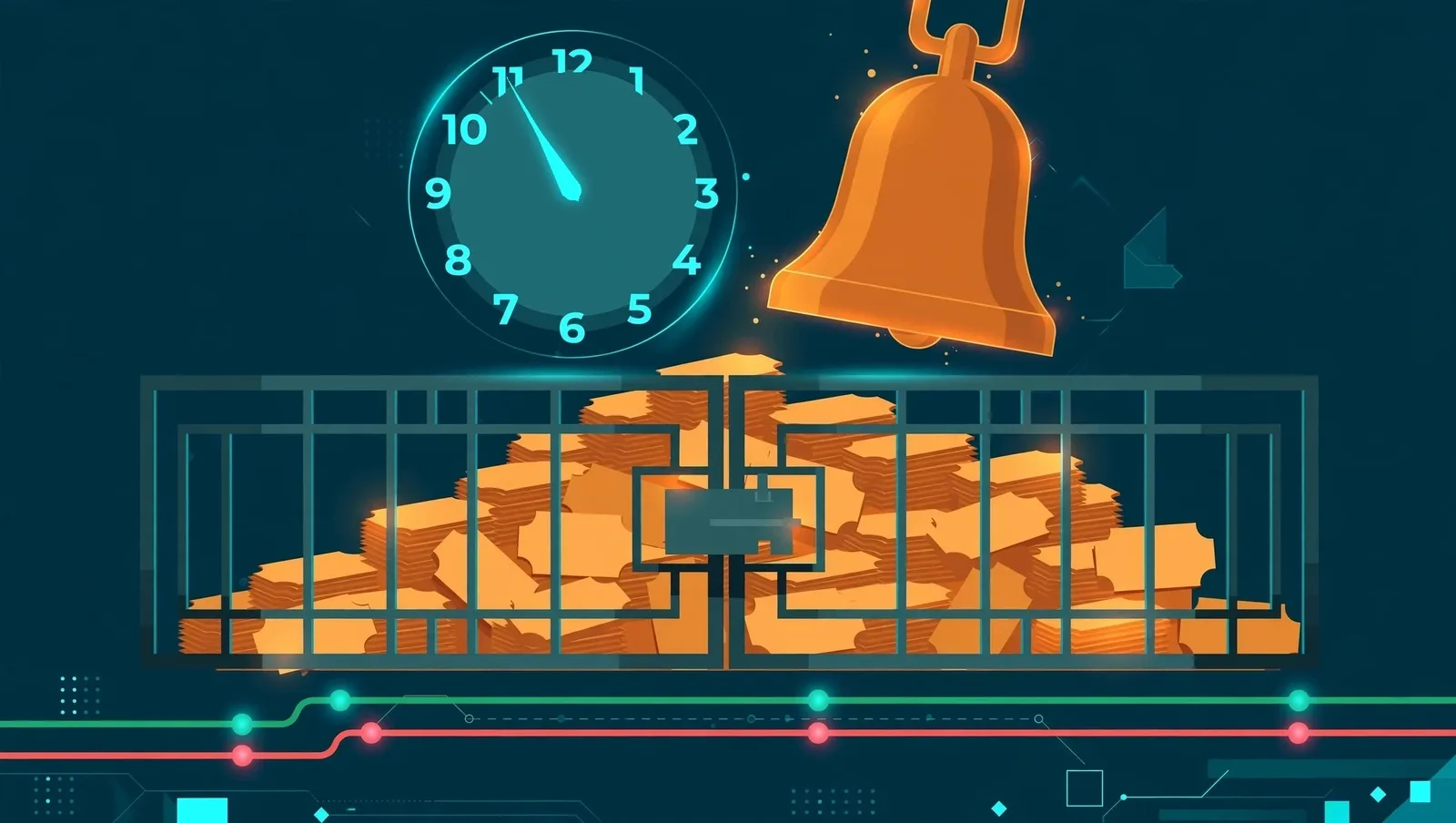
An analogy: a ticket gate that re-counts the whole queue every time one person leaves the line, and can only strike one name per recount. On a quiet morning it works. On the morning the whole city arrives and people keep leaving the line, the gate never finishes counting — and nobody gets in.
What this shows: the validation loop from the SEC's order, animated. Each recalculation could absorb only the first cancellation received during the previous one — so under a flood of cancellations, every pass created the need for another pass.
What happened on May 18, 2012
All times are Eastern Daylight Time, as documented in the SEC's order.
What this shows: the documented spine of the day — a 25-minute delay to the first print that concealed a two-hour-plus failure underneath it.
Before the open. At 7:56 a.m. Nasdaq announced the DOP would begin at 10:45 a.m., with secondary trading at about 11:00. From 10:45 it published indicative price and volume every five seconds. At 10:58, with the indicative price at $43.25, a large market-making firm asked Facebook's lead underwriter to extend the DOP by five minutes; the underwriter asked Nasdaq, and Nasdaq agreed. The SEC later found the conditions its own Rule 4120 allowed for such an extension were not met — the first rule bent that morning, before anything had broken.
11:05:10 a.m. — the loop. After the extension, Nasdaq attempted the cross. It started ten seconds late because of a randomization function — a deliberate small random delay — that Nasdaq had removed from its rulebook in 2007 but never removed from its systems; it had silently run in every Nasdaq IPO since August 31, 2007. The first calculation took 20 milliseconds — ten to twenty times the usual time, because of the order volume — and in that window a cancellation arrived. The validation check failed. The recalculation met two more cancellations and could only absorb the first; the check failed again; the next pass met four more. Each pass fell further behind the cancellations and new orders arriving during it. The system, in the SEC's words, was unable to catch up. No bulk print. No trading. The most watched stock opening in years simply did not happen.
The Code Blue call. Senior leadership convened an emergency "Code Blue" conference call, including the chief executive of the parent group and the heads of transactions, technology and regulation. Within minutes, engineers reported that the validation check was preventing the cross — but they did not know the specific cause, the loop. The senior vice-president relaying this to the call had, the SEC records, been unaware the validation check existed before that report. An attempt to override the check in place failed. The engineers then proposed the failover system proposal: switch to a duplicate matching engine and remove several lines of code that configured the validation check, so the backup would accept the calculated price and complete the cross. Two consequences were discussed: member connections would drop for a second or less during the switch, and orders cancelled during the calculation would be included in the cross anyway, with Nasdaq itself taking the opposite side of the resulting mismatch — meaning Nasdaq would end up holding a position. Cancelling or postponing the IPO was not discussed. Nasdaq had never tested this use of a failover; failovers were normally exact duplicates used for events like a power outage, not a vehicle for launching a modified system live.
About 11:25 a.m. — the decision. The Executive Vice-President for Transaction Services approved the failover for an 11:30 cross. Nobody on the call knew the precise cause of the failure. The approver recognised Nasdaq would very likely assume an error position (a position an exchange ends up holding because of its own systems error), but believed it would be very small — because he believed the calculation window it came from was less than a second. That belief was the hinge of the whole day, and it was wrong by nineteen minutes.
11:30:09 a.m. — a print built on stale orders. The failover completed the cross and released the bulk print: 75.7 million shares at $42. Continuous trading began on Nasdaq and other exchanges. Leadership believed the cross had included every order up to 11:30:09. It had not. The looping Cross Application had fallen 19 minutes behind the incoming orders, so the price and volume were calculated from orders and cancellations received only up to 11:11 a.m. More than 38,000 marketable orders placed between 11:11 and 11:30:09 were left out. About 8,000 of them entered the market when continuous trading began; the remaining more than 30,000 became what Nasdaq now calls "stuck" orders — neither executed nor cancelled, invisible in the cross, for over two hours.
What this shows: the gap between what the cross priced (orders to 11:11 a.m.) and what the market had actually sent (to 11:30:09 a.m.) — and the three consequences that fell out of that gap.
The warning that was seen and set aside. Just before the cross, Nasdaq's internal systems showed an indicative total of about 82 million shares. The bulk print said 75.7 million — a difference of about 6.3 million shares. Nasdaq's Chief Economist noticed the gap, and it indicated to him that some eligible orders may not have been handled properly. The SEC records, in one flat sentence, that Nasdaq did not address this issue during the minutes and hours that followed — even though a real-time status check, available at the time, would have shown the cross contained no orders entered after 11:11.
Confirmations stop — the second failure, caused by the fix. Within seconds of the print, members complained and Nasdaq's own monitoring confirmed it: no confirmations (the execution reports that tell a firm what it bought or sold, and at what price) were being delivered for cross orders. Members who had traded in the opening literally did not know their positions. The cause was the morning's fix itself. Confirmations are controlled by a separate Execution Application, which reconciles the cross against its own view of eligible orders before releasing them. That application had not been stuck in the loop — its view ran correctly up to 11:30:09 — so its totals could never match a cross built to 11:11. It marked the cross in error and withheld every confirmation. The same mismatch corrupted the quote feeds: Nasdaq's proprietary feed showed a stale crossed quote (a bid price higher than the asking price — a quote that should be impossible) at the top of the book, and the public Securities Information Processor feed showed only that crossed, incorrect quote.
11:35 a.m. — the halt that was declined. The Code Blue call discussed halting Facebook trading under Rule 4120(a), which allows halts when "extraordinary market activity" is occurring. The participants decided continuous trading looked normal, concluded the rule gave them no authority, and did not halt — while knowing the quote feeds were broken and confirmations had not been delivered, and without knowing why. Over the next half hour, two attempts to force the Execution Application to release confirmations failed. The halt decision was never revisited. At 12:01 p.m. the chief executive of a large market-making firm emailed Nasdaq's chief executive: since Nasdaq still could not send reports, "we are all trading blind" — should trading stop so everyone could catch up and understand their exposure? Senior staff received it at 12:06. Their view did not change. Members had by then waited 36 minutes for confirmations.
1:49:49 p.m. — everything arrives at once. After two parallel efforts — one team building manual emailed reports, another hunting an electronic fix — Nasdaq configured the Execution Application at about 1:45 to ignore the reconciliation error and deliver. At 1:49:49 p.m. all cross confirmations went out, and the 30,000-plus stuck orders were finally released or cancelled — the moment members, and Nasdaq itself, learned those orders had never been in the cross. About 13,000 of them were released into the live market at once, adding roughly 3 million more sell-side shares — the largest sell imbalance of the entire day — and Facebook's price fell 93 cents between 1:50 and 1:51 p.m. Only then did the quote feeds return to normal, with the public feed showing a firm quote for the first time in almost two and a half hours.
The spillover: Zynga. The same Cross Application also runs halt crosses (the mini-auctions that restart a stock after a trading halt). Zynga, a related stock, was halted twice that day on sharp price moves. Its first restart, due at 11:42 a.m., could not print until 12:27 p.m. because the application was still working through the Facebook backlog — and that print, too, covered only part of the orders, leaving about 365 Zynga orders mishandled the same way. After a second halt at 12:29 p.m., Nasdaq resumed Zynga trading at 1:35 without the required five-minute Display Only Period, because the period depended on systems still not working.
The damage
The stuck orders broke the market's most basic promise. Exchanges execute orders by price/time priority: a better price goes first, and at the same price, whoever arrived first goes first. It is, the SEC says, a fundamental rule. Every one of the more than 30,000 stuck Facebook orders — and the roughly 365 Zynga orders — was denied that priority: orders placed after the cross, at the same or worse prices, traded ahead of them for over two hours, in violation of Nasdaq's Rule 4757(a)(1) and of Section 19(g)(1) of the Exchange Act, which requires an exchange to follow its own rules.
The error position was 19 minutes big, not one second big. Because more sell orders than buy orders had been cancelled between 11:11 and 11:30:09, the mismatch Nasdaq had agreed to absorb left it short more than 3 million Facebook shares, valued at approximately $129 million — short meaning it owed shares it did not hold and had to buy them to deliver. Nasdaq's rules, the SEC found, did not permit it to use an error account for any purpose, and no rule allowed it or its affiliated broker-dealer, Nasdaq Execution Services (NES), to assume such a position at all. Covering the position (buying the shares back) through NES caused NES a net capital deficiency of approximately $26.5 million — net capital being the financial cushion a broker-dealer must maintain — after a $35.3 million regulatory deduction against its roughly $8.8 million of excess capital. That breached Section 15(c)(3) of the Exchange Act and Rule 15c3-1.
The profit that was also a violation. Facebook's price had fallen since the cross, so buying back the short position made money: approximately $10.8 million. Keep the two big numbers separate, because they are easy to swap: $10.8 million was the profit on covering the unauthorised short; $10 million was the SEC penalty below. A profit earned by breaking your own rules is not a silver lining — the SEC counted the covering trades themselves as further rule violations.
The settlement. On May 29, 2013, the SEC issued its order (Release No. 69655). Without admitting or denying the findings (beyond jurisdiction), Nasdaq and NES consented to censure (a formal public reprimand), cease-and-desist orders, and the undertakings described below. Nasdaq paid a $10 million civil penalty — the largest ever imposed on an exchange at that time. The order also folded in two unrelated earlier and later failures — compliance systems disabled in October 2011 and August 2012, breaching Regulation NMS and Regulation SHO — as background findings about monitoring; they are not part of the Facebook story itself. Separately, Nasdaq announced on May 21, 2012 that it would contribute the $10.8 million profit toward compensating members, and on July 26, 2012 it voluntarily proposed a $62 million accommodation program for certain members' Facebook losses, which the SEC approved on March 22, 2013.
How they recovered
Recovery on the day was the 1:49:49 delivery itself: bypassing the Execution Application's reconciliation released every confirmation, freed or cancelled the stuck orders, and normalised the feeds — at the cost of dumping 13,000 delayed orders into a live market in one second, with the 93-cent price drop that followed. There was no clean version of that step left by then; the choice was between continued blindness and a sudden, visible correction, and the delay had made the correction bigger.
After the day: Nasdaq disclosed the error-account gain on May 21 and committed it to member compensation, built the $62 million accommodation program through a formal rule filing (the route it had not had on the day — a rule, approved in advance, for exactly this situation), and reported NES's capital deficiency to the SEC and FINRA as the rules require. The SEC settlement then converted the lessons into binding undertakings, with a chief-executive certification of compliance due by December 31, 2013.
The fix: technology and controls that came out of it
The undertakings in the SEC's order are unusually concrete, and they read as a direct reply to each failure above:
Close the ports when the calculation starts. For IPO and halt crosses, Nasdaq undertook to close its order ports to new cross orders and cancellations once the cross calculation is triggered. This removes the race entirely: nothing can change during the calculation, so the validation check has nothing new to chase. For opening and closing crosses, the system was changed to absorb bursts of order changes in one recalculation rather than one recalculation per change — the exact design limit that looped, engineered out. Failed validation checks would also produce richer log entries, so the next team can see why a check failed instead of only that it failed.
Make the rulebook and the code agree. Nasdaq undertook to amend Rule 4120 to actually provide for the randomization interval its systems had run, unauthorised, since 2007 — and to provide for underwriter-requested extensions of the Display Only Period, the extension it had granted without authority that morning. The deeper lesson is the drift itself: for nearly five years, the published rule and the production code said different things, and nobody's process compared them.
Independent monitoring that does not trust the trading system. New automated and operational checks for Regulation NMS and Regulation SHO compliance included an alert for suspect short sales that operates independently of Nasdaq's trading system, an hourly trade-through monitoring tool, and procedures to verify that compliance applications are actually receiving their market data. Monitoring that shares the failing system shares its blindness — the same reason the Execution Application, an independent reconciler, was the one component that correctly refused to bless the bad cross.
Change management with regulators inside the room. Nasdaq adopted a Global Change Management Policy with a formal Change Approval Board spanning technology, business and legal staff; the Regulatory Group was expanded, joined daily software change reviews, took part in planning for all major trading-system changes, and had to approve major changes before production. A standardised global change tool gave staff a single view of every change across the enterprise. A dedicated system and performance engineering team took on daily performance monitoring, and a new quality-assurance organisation was created to focus on integration testing of trading systems — testing components together, which is precisely where the cross-versus-Execution-Application mismatch lived. NES, separately, had to rewrite its procedures for monitoring net capital moment to moment.
What this means for you
Enterprise network engineers
Your version of the validation loop is any retry, re-sync or re-convergence mechanism that does work proportional to the churn it is trying to absorb: a routing protocol reconverging under flapping links, a controller re-pushing state to every device after every small change, a monitoring poller that falls behind and then works through a stale queue as if it were current. Ask the Nasdaq question of each one: if changes arrive faster than one processing pass, does this catch up, shed load, or loop forever while falling silently behind? And note the stale-print failure in your own terms: a system that reports success using 19-minute-old state is worse than one that reports failure, because everyone downstream acts on the report.
Hyperscaler engineers
Three habits from this case scale directly. First, load-test at real scale, not a capped fraction: 40,000 test orders against 496,000 real ones is the same error as load-testing a launch at a tenth of forecast traffic. Second, never ship a modified system through the failover path untested: a backup that differs from the primary is not a backup, it is a second, unreviewed production system that activates at the worst possible moment. Third, treat a reconciliation mismatch as a stop signal, not noise: the one component that refused to proceed — the Execution Application — was right, and the day's final fix was to override it. Independent checkers only protect you if overriding them requires more than a deadline and a conference call.
HFT / low-latency engineers
This is your market structure, so the details should sting. Price/time priority is not a feature, it is the product — 30,000 orders silently losing their place in the queue is an integrity failure, not an outage statistic. The decision failures are equally familiar: a hotfix approved in minutes without a root cause, a known discrepancy (82 million versus 75.7 million shares) noticed by a named human and not escalated, a halt decision made once and never revisited as facts worsened, and an error-account position sized by an assumption ("less than a second") that nobody verified against the system's actual state. In low-latency environments the equivalent discipline is mechanical: pre-defined kill and halt criteria decided before the event, position and exposure limits enforced by the system rather than estimated on a call, and a hard rule that a fix you cannot explain does not go live into an open market.
Try it yourself
The quietest failure in this case ran for almost five years: Nasdaq's rulebook said the randomization delay had been removed in 2007, while the production code still applied it to every IPO. Rule and reality had drifted apart, and no process compared them. You can practise the comparison habit with Packet Path's free Network Config Verifier: paste configurations side by side and it flags the mismatches — the settings that should agree and do not. The tool is for network configs, not exchange code, but the discipline is identical: do not assert that two things match. Diff them.
Sources
Primary source — U.S. Securities and Exchange Commission, In the Matter of The NASDAQ Stock Market, LLC and NASDAQ Execution Services, LLC, Securities Exchange Act Release No. 69655, Administrative Proceeding File No. 3-15339 (May 29, 2013). All incident mechanics, times, figures, rule violations, sanctions and undertakings in this case are taken from this order, opened and read in full: https://www.sec.gov/litigation/admin/2013/34-69655.pdf
U.S. Securities and Exchange Commission, press release 2013-95, "SEC Charges NASDAQ for Failures During Facebook IPO" (May 29, 2013) — the Commission's summary of the same order, including the $10 million penalty as the largest ever against an exchange at that time: https://www.SEC.Gov/news/press/2013/2013-95.htm
The $62 million accommodation program figure is taken from the order itself (footnote to paragraph 40, citing Exchange Act Release No. 69216, March 22, 2013, approving the program Nasdaq voluntarily proposed on July 26, 2012).
- The root cause was a design limit, not a crash: the IPO cross recalculated after every cancelled order but could only absorb one cancellation per recalculation — under Facebook-scale volume, each new calculation fell further behind and the check looped for 19 minutes.
- The fix made it worse in ways nobody had modelled: removing the validation check on a live failover system let the cross complete, but on stale orders — and it broke confirmations, because a second system that still reconciled correctly refused to accept the result.
- A number that did not match was seen and set aside: the internal total said about 82 million shares, the print said 75.7 million — a 6.3 million share gap that signalled missing orders and was not acted on for hours.
- Nasdaq tested at 40,000 orders and got over 496,000: the week's test crosses were capped at less than a tenth of the real order flow on the day.