Rogers 2022: One Deleted Filter Took Down a Country's Network
In the early morning of July 8, 2022, Rogers — one of Canada's largest phone and internet companies — was in phase six of a seven-phase upgrade of the shared core network that carried both its mobile and its home internet traffic. Staff cleaning up router configuration files deleted one policy filter. That filter was the only thing holding back a flood of internet routing information, and the core routers behind it had no overload limit of their own. They crashed within minutes. More than 12 million customers lost wireless and wireline service, including 9-1-1 calling. This is the documented story from the independent report the regulator commissioned.
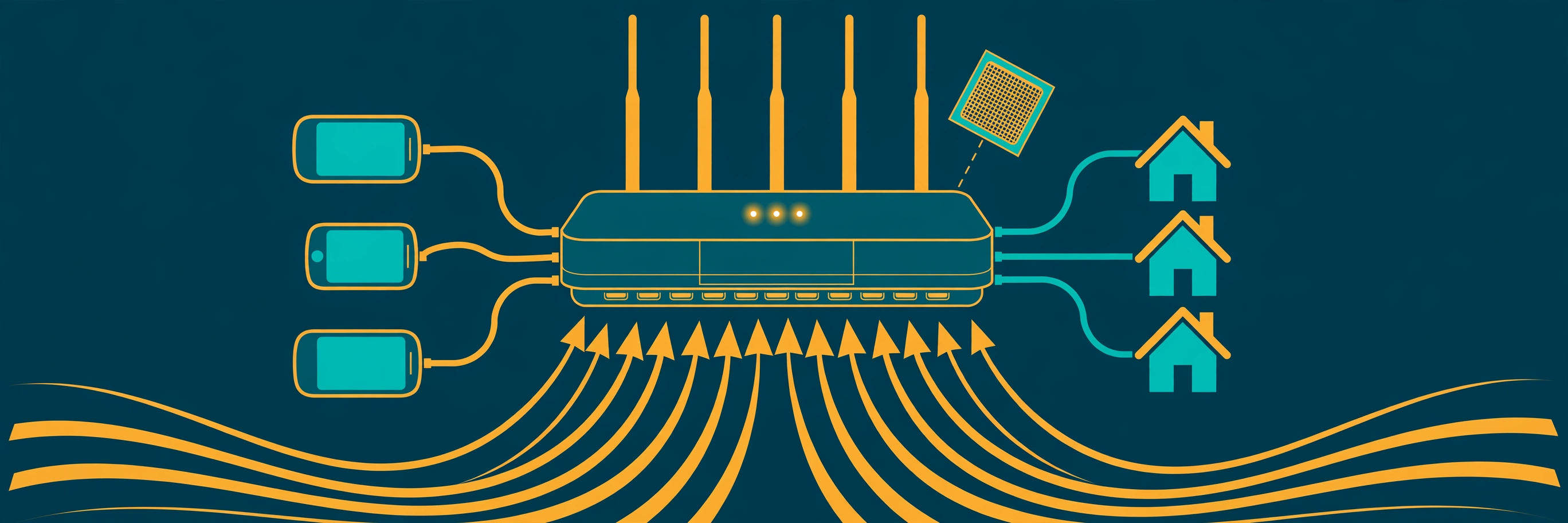
The short answer
On July 8, 2022, Rogers Communications, one of Canada's largest telecommunications companies, lost its national network for most of a day. The independent assessment commissioned by Canada's regulator, the Canadian Radio-television and Telecommunications Commission (CRTC), dates the outage from 04:58 Eastern Daylight Time (EDT) on July 8 to 07:00 EDT on July 9, 2022, as services were gradually restored, and says more than 12 million customers lost wireless and wireline services. The cause was not an attack and not a design flaw. During a routine upgrade, staff cleaning up configuration files deleted an Access Control List policy filter — a set of rules in a router that controls what traffic and routing information passes through it. That filter was holding back a flood of internet routing information. Behind it, the core routers had no overload limit. The flood crashed them within minutes — and because mobile, home internet, the network used to manage the equipment, and the staff's own phones all depended on that same core, Rogers lost the network, the tools to fix the network, and the ability to talk to each other in the same failure.
The company: what Rogers did
Rogers Communications is a Canadian telecommunications company — in plain terms, it sells mobile phone service, home internet, home phone and business connectivity across Canada. For this story, one fact about how it built its network matters more than any other.
Rogers' wireless and wireline networks share a common Internet Protocol (IP) core network. The core is the middle of the network: it gathers traffic from the parts that connect to customers and routes it where it needs to go, inside Rogers and out to the internet and other providers. So the same core carried a phone call from a mobile, a family's home internet, a business connection and a 9-1-1 emergency call.
Sharing a core that way is common. The independent report is explicit that this was not a design flaw — it is a normal choice that balances cost and performance, used by many providers. The catch is the blast radius (how much fails at once when one piece fails). If the shared middle breaks, everything that passes through it breaks together. That is exactly what happened.
The problem: a seven-phase upgrade, and a risk score that fell as it succeeded
In the weeks before July 8, Rogers was carrying out a seven-phase upgrade of that IP core. A phase is one planned step of a larger change, done in its own maintenance window (a scheduled period, usually overnight, when engineers are allowed to change the live network). The outage happened during phase six.
Now the sharpest lesson in the whole case. Rogers first assessed the seven-phase process as "High" risk. As the earlier phases were completed successfully, its risk assessment algorithm downgraded phase six to "Low". A Low rating removed requirements: no additional scrutiny, no higher levels of approval, and no laboratory testing (testing the change on lab equipment that mirrors the real network before touching production).
The independent report's verdict on that downgrade is direct: downgrading a change to an Access Control List filter in a routing policy to Low "contravenes industry norms", which require high scrutiny and lab testing before such a change goes into production. In plain English: the system treated a string of successes as proof the next step was safe. Success became the reason to check less — on the one step where checking mattered most.
The second quiet fact: the core routers had no overload protection. An overload limit is a setting that says, in effect, "accept at most this much routing information; beyond that, protect yourself." The report says the failure could have been prevented had the core routers been configured with such a limit. They were not. The policy filter on the distribution routers (the layer between customers and the core) was the only barrier.
An analogy: imagine one dam gate holding back a reservoir, with no overflow spillway behind it. The gate is fine — until the day someone removes it during routine maintenance, believing the water level is low because the last five inspections went well.
What this shows: the setup before anything went wrong. Every service passed through one core, one filter held back the routing flood, and there was no second barrier behind that filter.
What happened
All times are Eastern Daylight Time, as the independent report frames them.
The cleanup. During phase six, Rogers staff were cleaning up the configuration files of the distribution routers — tidying settings, the network equivalent of clearing out an old filing cabinet. In that cleanup, they deleted the Access Control List policy filter. The independent report calls this a change management oversight: the change process, including its audits of change parameters, failed to flag the change. And because the risk rating was now Low, there was no lab test and no higher approval standing between the edit and the live network.
The flood and the crash. With the filter gone, IP routing information — the directions routers use to know where to send traffic — flooded from the distribution routers into the core routers, beyond their capacity to process it. The core routers crashed within minutes of the filter's removal. When they crashed, user traffic could no longer be routed anywhere. Mobile service, home phone, internet, business wireline connectivity and 9-1-1 calling ceased functioning.
The scale. More than 12 million customers lost wireless and wireline services — mobile subscribers, home internet users, corporate customers, and institutions that provide critical services, including, as the report names as an example, Interac e-Transfer and electronic payment services. The CRTC's letter four days later records the human side in the regulator's words: the event "disrupted the lives of several millions of Canadians and prevented access to such services as 9-1-1 and emergency alerting in addition to other critical infrastructure and services," and complaints included being unable to work, loss of income, and lack of access to banking.
What this shows: the chain in motion. The dashed lines are the routing flood moving from the unfiltered distribution routers into a core that had no limit — and the last box is why this outage lasted so long: the repair path died with the patient.
The damage
The headline damage is duration and reach: a national provider down from the early morning of July 8 into July 9, with more than 12 million customers affected across every service the company sold. No dollar-loss figure appears in the primary sources opened for this case, so none is printed here.
The safety damage is the part the regulator put first. Access to 9-1-1 and emergency alerting was prevented, in the CRTC's words. The Commission also recorded a communication failure inside the failure: in the first hours, Rogers provided few details on its webpage or social media, and failed to provide Canadians with information about alternate means of reaching 9-1-1 in an emergency. People did not just lose service; they were not told how else to call for help.
There was also a trust gap at the end. The CRTC letter notes that by Monday, July 11, many customers were still reporting service interruptions, despite messaging on Rogers' website indicating that as of July 9 services had been restored and networks were nearly fully operational. Declaring recovery before customers experience it is its own damage — it tells people still offline that the problem must be them.
Finally, the regulator put this outage in a pattern, carefully: Rogers publicly attributed the cause to a maintenance upgrade in its core network, which the Commission said was "reminiscent of another significant network outage in April 2021 that Rogers similarly attributed to a software update." That one line is all the primaries opened here say about 2021, and it is all this page claims.
How they recovered
Recovery was slow for three documented reasons, and each one is a lesson in itself.
First, the repair door was locked from the inside. Rogers had a management network — the separate path engineers use to reach equipment to troubleshoot and repair it — but that management network relied on the failed IP core. When the core failed, remote staff could not reach it. The network operation centre (the NOC, the room that runs the network) and other critical sites had no redundant connectivity from alternative providers. Rogers had to dispatch staff to remote sites to physically access the affected routers, which delayed recovery.
Second, the team could not talk to each other. Rogers staff relied on the company's own mobile and internet services to communicate. When both failed, critical incident staff could not communicate effectively in the early hours. Rogers had to send SIM cards from other mobile operators to its remote sites so its own people could get wireless connectivity. The fix for the network had to be coordinated over a rival's network, delivered by hand.
Third, nobody knew the cause for about 14 hours. Staff did not initially have access to the failed routers' error logs, and multiple configuration changes had been made in the same maintenance window, so they could not tell which change ticket to roll back. The root cause was misdiagnosed in the initial hours. Once it was identified, the report says, restoration proceeded methodically and services returned gradually, through to the 07:00 EDT July 9 end of the outage window.
Then the regulator stepped in. On July 12, 2022, the CRTC wrote to Rogers demanding comprehensive answers by July 22, 2022 — 22 questions on the current outage alone, plus sections on emergency services, past outages and customer compensation, noting the CEO's commitment to proactively apply a credit to all impacted customers. The Commission later commissioned the independent assessment by Xona Partners that this case is built on, published in November 2024.
The fix: technology and controls that came out of it
The independent report assessed the combination of measures Rogers took after the outage as "satisfactory" to improve resiliency and address the root cause. The documented fixes:
Overload safeguards in the core. Rogers implemented safeguards in the configuration of its core routers to prevent flooding with IP routing data — the missing second barrier, added after the fact.
A management network that does not die with the patient. Rogers implemented a separate physical and logical management network, and deployed backup connectivity from third-party providers to its NOC and other critical remote sites. Physical and logical separation means the repair path shares neither the hardware nor the routing of the network it repairs.
Change management rebuilt around the actual failure. A new risk assessment algorithm (the old one had downgraded this change to Low), more collaboration between operations and engineering, additional lab testing of configuration changes, automation in the change process, and tools to validate router configuration changes — a machine check that a config edit does what it claims, before it reaches production.
Incident management that assumes the network is the thing that broke. Improved guidelines and leadership roles, alarm prioritisation (so the important alarms are not buried), enhanced automated rollbacks to previous configurations, and — the SIM-card lesson, institutionalised — all incident response and crisis team members equipped with backup communications from third-party providers.
The big structural fix — still in progress at the report date. Rogers decided to separate the IP core: a new core for wireless, the existing core staying for wireline, so a failure in one cannot take the other. As of the November 2024 report, Rogers had not yet finalised that implementation; it remained a work in progress. This page reports it that way, dated — not as completed.
The report also lists lessons for every carrier, and they read as a checklist: router overload protection; a management layer physically and logically separate from the data network; third-party backup connectivity for the NOC; multi-team audits of configuration changes; lab tests that mirror production; limiting the number of changes per maintenance window, with automatic rollback; backup staff communications; and practising failure drills.
What this means for you
Enterprise network engineers
This is your case, in your vocabulary. Three checks to run on Monday: (1) Where is your single filter? Find the one ACL, prefix limit or policy whose deletion would flood something downstream — then ask what limit exists on the receiving device itself. A maximum-prefix or overload setting is cheap; Rogers shows the price of its absence. (2) Does your risk process downgrade changes because the last ones worked? If a run of successes lowers scrutiny automatically, your process has Rogers' bug. Some change types — routing policy and filter changes on core devices — should be floored at high scrutiny no matter the streak. (3) Can you manage your network when your network is down? If your out-of-band management rides the production core, and your team's phones are on the network you run, you do not have a recovery plan — you have a hope. Test the management path by simulating its independence, not by reading its diagram.
Hyperscaler engineers
Your version is the shared control plane and the global config push. Rogers' phase-six downgrade is your automated canary promotion that widens because the early cells stayed green — the question is whether any class of change is exempt from promotion-by-success and always gets full review and a mirrored-environment test. And Rogers' 14 hours without a root cause is your observability lesson: multiple changes in one window plus no access to the failed component's logs equals a misdiagnosed first half of the incident. Limit changes per window, make rollback automatic and per-change, and keep telemetry reachable when the data plane is not.
Try it yourself
The deleted item in this case was an access control list — and the missing habit was checking what a config change actually does before it ships. Practice both free: the ACL Analyzer lets you paste an access list and see what it really permits and blocks, and the Network Config Verifier compares two device configurations side by side and flags the differences — the exact comparison that turns "we cleaned up the configs" into a reviewed, visible diff.
Sources
Primary source (the spine of this case) — Xona Partners Inc., Assessment of Rogers Networks for Resiliency and Reliability Following the 8 July 2022 Outage, November 2024, commissioned by the CRTC (ISBN 978-0-660-69962-2): the outage window 04:58 EDT July 8 to 07:00 EDT July 9, 2022 and more than 12 million customers; the shared IP core and the seven-phase upgrade with the outage in phase six; the deleted Access Control List policy filter, the flood and the core crash within minutes; the absence of overload protection; the High-to-Low risk downgrade and the industry-norms finding; the shared-core scope finding; the three restoration factors (management network dependence, staff communications and SIM cards, about 14 hours without a root cause and the initial misdiagnosis); the post-outage measures assessed satisfactory, and the core-separation status as a work in progress in November 2024: https://crtc.gc.ca/eng/publications/reports/xonarp2023.htm
Primary source (the regulator's framing) — Canadian Radio-television and Telecommunications Commission, Commission letter to Rogers Communications Canada Inc., July 12, 2022: millions disrupted, 9-1-1 and emergency alerting affected, no alternate 9-1-1 guidance provided, customers still reporting interruptions on July 11 despite the July 9 restored messaging, the April 2021 comparison in the Commission's words, the 22-question request for information due July 22, 2022, and the record of the CEO's commitment to proactively credit all impacted customers: https://crtc.gc.ca/eng/archive/2022/lt220712.htm
Notes on scope: Rogers' own July 22, 2022 response to the CRTC's questions is listed in the CRTC record, but the file could not be opened for this case, so no figure that rests only on that filing is printed here. No dollar-loss figure, credit length, per-province customer split or payment-network transaction count is printed, because none appears in the two primary sources above. The core-separation status is reported as of November 2024, the date of the independent report.
- One deleted filter was the whole barrier: the core routers had no overload limit, so when the Access Control List policy filter was removed, routing data flooded in and the core crashed within minutes.
- Success lowered the guard: Rogers first rated the upgrade High risk, but as earlier phases succeeded its risk algorithm downgraded phase six to Low — removing extra scrutiny, higher approvals and laboratory testing.
- A shared core is not a design flaw, the independent report found — but sharing it made the scope catastrophic: wireless, wireline, the management network and staff communications all failed together.
- Recovery was slowed by the failure itself: no root cause for about 14 hours, staff dispatched physically to routers, and SIM cards from other operators sent out so incident staff could talk to each other.