Southwest Airlines: The Holiday Meltdown That Broke the Phones, the Alerts and the Refunds
Between December 21, 2022 and January 2, 2023, Southwest Airlines cancelled or significantly delayed more than 16,900 flights and stranded over two million passengers in a winter storm. What turned a bad week into a record penalty was what happened next: the phone lines jammed, the flight-status alerts failed, and the emergency refund website silently threw away valid requests. The U.S. Department of Transportation's consent order — the primary source for this case — documents those three failures in detail and imposed a $140 million penalty, 30 times larger than any DOT consumer-protection penalty before it.
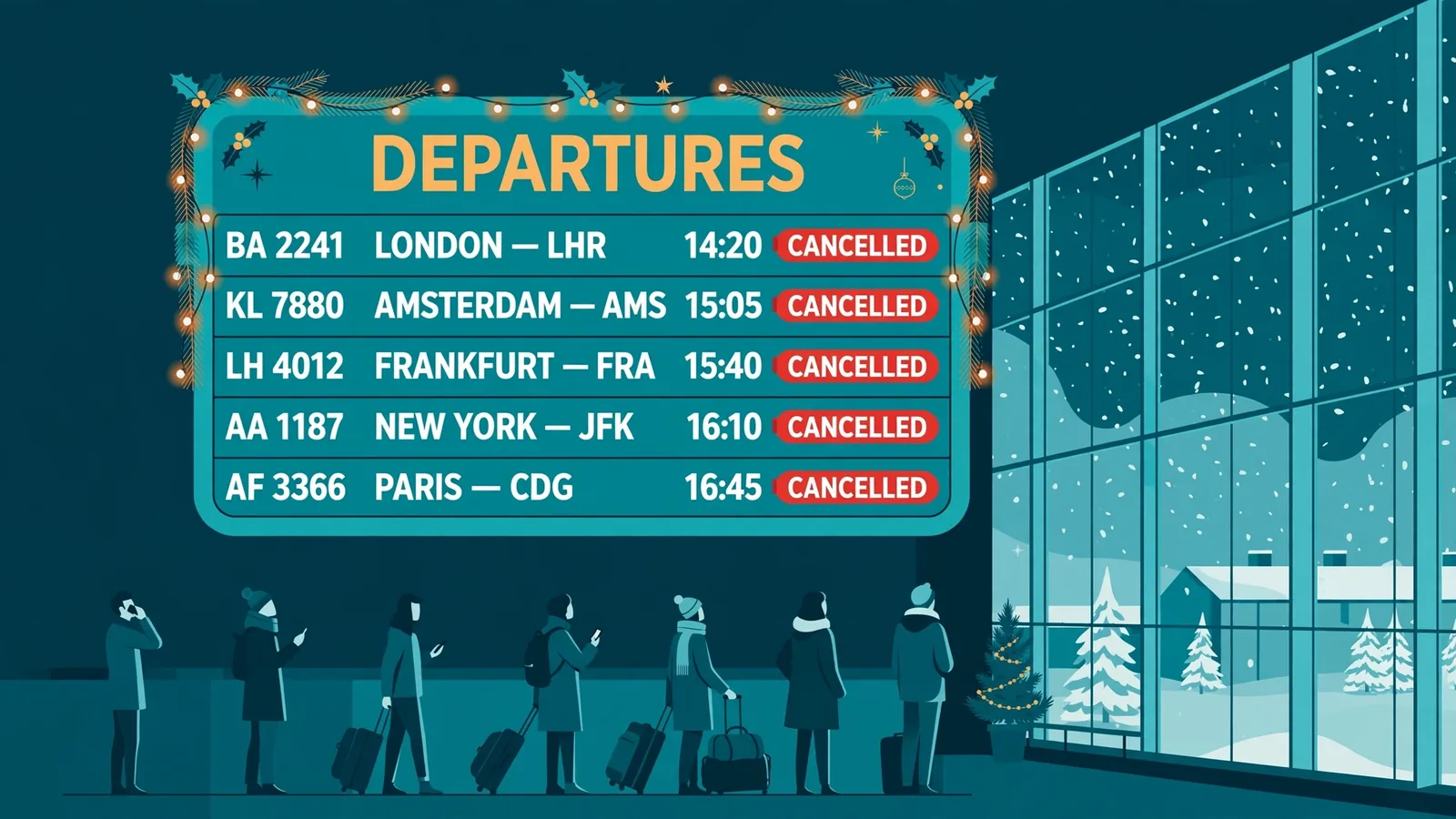
The short answer
Over the 2022 Christmas holiday, a severe winter storm — Winter Storm Elliott — hit the United States, and Southwest Airlines unravelled. Between December 21, 2022 and January 2, 2023, Southwest cancelled or significantly delayed over 16,900 flights, affecting over two million passengers. Airlines across the country were disrupted by the same storm. What made Southwest's week a landmark case, documented in the U.S. Department of Transportation's (DOT) consent order — a settlement in which a company agrees to penalties and fixes without a court fight — is that every system passengers needed to recover then failed under the load. The call centre was overwhelmed until callers got busy signals and hours-long holds. The flight-status notification process broke down for ten days. And the emergency refund website silently discarded valid requests. DOT found three sets of law violations, counted more than $600 million already paid back to passengers, and imposed a $140 million civil penalty — 30 times larger than any previous DOT penalty for consumer-protection violations. One honesty note up front: the consent order investigates how Southwest cared for passengers, not the internal mechanics of why its flight operation itself could not recover — DOT closed that separate scheduling investigation without a finding, and this case does not invent one.
The company: what Southwest Airlines did
Southwest Airlines is a U.S. air carrier — an airline — headquartered in Dallas, Texas, where DOT's investigators later conducted on-site audits of its customer-care records. In its response inside the consent order, Southwest describes a 52-year history and a reputation built on customer care, and says it employs several thousand U.S.-based telephone representatives providing 24/7 coverage, 365 days a year — a detail that matters, because the phone line is exactly where this story breaks.
Southwest promotes that call centre as the way customers talk to a representative at any hour, particularly during flight disruptions. Its published policy promises flight-status updates by text or email using the contact details on the reservation, plus a status lookup tool on its website and apps. And under its Customer Service Plan — the written promises an airline must legally keep — refunds are due promptly when the airline cancels or significantly changes a flight: for credit-card purchases, the order explains, within seven business days of a complete request; for cash and cheque purchases, within 20 days. Flight-status changes must be notified within 30 minutes of the airline becoming aware of them.
Those promises had just been strengthened. In September 2022, at DOT's urging, Southwest had significantly changed its Customer Service Plan so passengers hit by a cancellation or delay caused by the airline itself (a controllable disruption, as opposed to weather) were entitled to reimbursement for meals, hotels and ground transportation. Three months later, that plan became the yardstick for the biggest disruption in the company's history. Why this matters: Southwest was not judged against vague expectations. It was judged against its own written promises, plus the law behind them.
The problem: a storm, then a surge no support system was sized for
The trigger was weather. Southwest's position in the order calls Winter Storm Elliott unprecedented: blizzards, high winds, snowfall and record cold temperatures creating unanticipated operational challenges, with the airline proactively cancelling and delaying flights to keep customers safe. DOT does not dispute the storm in the order — and, importantly, the order does not document the internal operational chain (crew positioning, scheduling software, network design) that secondary coverage discusses freely. Those details are not in this primary source, so they are not in this case.
What the order documents, in detail, is the second disaster: the surge. When 16,900 flights are cancelled or badly delayed in thirteen days, the operation's problem becomes a communications and recovery problem. Two million people simultaneously need the same four things: to know whether their flight is running, to talk to a human, to rebook, and — for those who give up — to get their money back. Each of those needs runs on a system with a capacity limit: a phone queue, an automated messaging pipeline, a website, a refund process.
An analogy: a hospital can survive a terrible night in the emergency department. What it cannot survive is the same night with the phone system down, the paging system sending yesterday's messages, and the discharge desk shredding every third form without telling anyone. The storm filled Southwest's emergency department. The order is about the phones, the pagers and the forms.
What this shows: the cascade DOT actually documented, animated. One surge of passengers hit three separate support systems at the same moment — and each system failed in its own way.
What happened: December 2022 – January 2023
All dates and figures are from the consent order and DOT's release announcing it.
What this shows: the documented spine of the case — a thirteen-day operational window, a ten-day notification failure inside it, and consequences that ran for more than three years afterwards.
The phones. Passengers who tried to call Southwest's customer-care number (1-800-I-FLY-SWA) met a system at its limits. Investigators found the call centre was overwhelmed: at times the queue was completely full, so new callers simply received a busy signal. Calls that did connect sometimes sounded garbled or choppy. At one point the hold music stopped, and Southwest had to drop thousands of calls to reinstate it — leaving countless callers believing the phone system was not working at all. Those who got through and stayed on the line waited hours in some cases, and some calls dropped after those hours of waiting. For several days, Southwest's own website carried a public notice: hold times were "currently averaging more than 2 hours and have been as high as four hours." DOT's finding was blunt: Southwest failed to provide adequate customer-service assistance to hundreds of thousands of consumers.
The alerts that never arrived. The law requires a status notification within 30 minutes of the airline learning of a cancellation, diversion or delay of 30 minutes or more. Between December 19 and 29, 2022, investigators found, Southwest's process for sending automated outbound messages (AOM) — its automated texts and emails — failed: notifications were delayed, inaccurate, or not sent until after the flight's scheduled departure time. Many passengers received nothing in any form; others could not reach the website for status because of apparent errors, and learned their flight was cancelled only after driving to the airport. DOT's finding: Southwest failed to provide prompt notifications to over one million passengers. Southwest's position in the order is that it sent proactive messages, that most passengers still received updates at least four hours before departure, and that after its vendors flagged the delays it increased processing capacity — by December 28 it was again sending alerts within 30 minutes, and that increased capacity remains in place.
The refund website that said nothing. Before December 2022, refund requests came through the call centre, airport ticket counters, or the website's Contact Us page. For the meltdown, Southwest quickly built a dedicated Microsite asking for just three things: first name, last name, and the PNR — the six-character passenger name record, the booking confirmation code. The site processed the vast majority of requests quickly. Its design, however, contained a trap, examined in the next diagram: any request whose three entries were not exactly right was classed "invalid" and simply not processed — with no error message, and no contact details collected to follow up.
What this shows: how the Microsite failed, step by step, from the order's own findings — including the two classic look-alike character mistakes (zero for the letter O, one for the letter l) that the order names.
Three more refund failures hid underneath. First, a date-range trap: the Microsite was built for flights scheduled December 24, 2022 to January 2, 2023, so requests for the storm's first days — December 21 to 23 — were not promptly processed, and passengers were not told about that limit until sometime on December 29. Second, a recycled-code bug: Southwest reuses its six-character PNRs, so the same code later identifies a different passenger; when refunds were processed, names stopped matching the recycled codes and requests were rejected for a "name mismatch" — refunds arrived only after DOT alerted Southwest to its own error. Third, the extras: thousands of passengers were not promptly refunded optional service fees — pet fees, upgraded boarding and similar add-ons they paid for but never got to use. And passengers who had paid with a gift card were, in thousands of instances on one fare class, given a non-transferable travel credit instead of the transferable refund they were owed; Southwest made those credits transferable only after investigators raised it.
The investigation. DOT's Office of Aviation Consumer Protection ran what its release calls a rigorous and comprehensive investigation: tens of thousands of pages of documents, several multi-day, in-person audits and site visits at Southwest's Dallas headquarters, thousands of consumer complaints reviewed, airports and other third parties consulted, and assistance from the Department of Justice's Consumer Protection Branch. It was that audit work — not Southwest's own monitoring — that surfaced the silent Microsite rejections and the recycled-PNR error.
The damage
Keep the five money figures separate, because they are easy to swap and they mean different things. More than $600 million is what DOT says it ensured Southwest paid passengers from the meltdown itself, in refunds and reimbursements for meals, hotels, ground transport and alternative travel. $140 million is the civil penalty on top of that — 30 times larger than any previous DOT penalty for consumer-protection violations. $90 million is the size of the future-passenger voucher fund the penalty created. And DOT's combined total for the meltdown is over $750 million, the vast majority of it going to passengers.
The penalty itself splits three ways, by design. Only $35 million is cash to the U.S. Treasury, paid in instalments ($12 million by January 31, 2024, $12 million by January 31, 2025, and $11 million by January 31, 2026). $72 million is an offset — credit against the penalty — for funding the $90 million voucher system described below. And $33 million is a credit recognising money Southwest had already spent voluntarily: the 25,000 points gesture. DOT says it structured the penalty this way deliberately, so most of the money reaches passengers rather than the government, and to incentivise other airlines to make similar gestures in future disruptions.
The human damage sits underneath the figures in the findings themselves: hundreds of thousands unable to get adequate help by phone, over a million not promptly told their flight's status, thousands deprived of refunds they believed were coming, and travellers who drove to an airport to discover a cancellation that an automated message should have delivered hours earlier. Southwest's own framing, recorded in the order, is that it sincerely regrets the inconvenience, cooperated fully, worked tirelessly to repair trust earned over 52 years — and that it disagrees it violated the law, entering the settlement without admitting any violation. Both positions are part of the record; the findings and the penalty are DOT's.
How they recovered
During and just after the disruption, on Southwest's account in the order, it began reimbursing hotels, meals, transportation and other out-of-pocket costs immediately — in its words, well beyond the amounts and categories in its Customer Service Plan — and honoured reasonable requests for alternative transportation such as other airlines' tickets, Amtrak or rental cars for the December 24 to January 2 window. It built the Microsite quickly to take refund requests at scale, whatever that tool's flaws proved to be. And in January 2023 it gave 25,000 Rapid Rewards points — approximately $300 in value — to every customer significantly affected by the disruption, a gesture DOT later valued as the $33 million penalty credit.
Fixing what the auditors found came next: the silently rejected Microsite refunds were identified and paid after DOT's audit; the name-mismatch refunds were paid once DOT alerted Southwest to the recycled-PNR error; and the non-transferable gift-card credits were converted to transferable ones after investigators raised the issue. Notice the pattern — each of those recoveries began with an outside audit finding, not an internal alarm. That is itself one of the case's lessons.
The settlement closed the story a year later. The consent order was issued on December 15, 2023 and announced on December 18: a cease-and-desist order covering the three violation areas, the $140 million penalty structured above, and — as part of the same settlement — DOT closing its separate unrealistic-scheduling investigation without making a finding either way.
The fix: technology and controls that came out of it
Capacity that stays increased. Southwest states in the order that it significantly increased both its automated-message (AOM) capacity and its call-centre capacity during the disruption, working with its vendors, and that the increased capacity remains in place. That is the direct engineering answer to the two loudest failures: a notification pipeline and a phone queue sized for an ordinary bad day will both saturate on the worst day, which is the only day their size really matters.
Self-service so the phone is not the only door. Southwest's stated roadmap in the order adds increased flexibility to change and cancel flights through an online self-service tool, automatic bag tracking, online self-service for mishandled bags, and increased real-time, day-of-travel communication. Read against the findings, the logic is plain: every request a passenger can complete alone is one fewer call in a queue that has already shown it can fill completely.
A compensation system with teeth, for next time. The order's most novel control is forward-looking. From April 30, 2024 to April 29, 2027, Southwest must provide $30 million in vouchers per year ($90 million total): on request, any passenger whose controllable cancellation or significant delay makes them arrive three or more hours late gets a transferable voucher of $75 or more, valid for at least a year. Southwest had to publish the policy publicly and write it into its Customer Service Plan by April 23, 2024, and must file sworn annual reports each May documenting the vouchers issued. If it issues less than $30 million in a year, 80 percent of the shortfall is paid to the Treasury instead — a control designed so the promise cannot quietly evaporate.
The design lessons the order leaves behind are not written as rules, but they are unmistakable in the findings: never let a customer-facing form fail silently (an error message and a follow-up path would have converted thousands of lost refunds into a minor delay); never ship a hidden scope limit (the December 24 start date cost the earliest storm victims a week of false confidence); treat recycled identifiers as a data-integrity risk, not a convenience; and audit the recovery systems themselves during an incident, because Southwest's refund pipeline was failing in ways only an external audit caught.
What this means for you
Enterprise engineers and operations teams
Your version of this case is any incident where the primary system gets the attention and the support systems — status page, notification pipeline, ticketing queue, support phones, refund or rollback tooling — are sized for normal load. Southwest's documented failures were all in that second ring. Test those systems at incident scale, not average scale: a queue that fills and returns a busy signal, a notification job that falls hours behind while reporting success, and a self-service form with silent rejection are all capacity and feedback-design failures, and all three are findable in a load test or a game day — if anyone thinks to test the recovery path and not just the product. The second lesson is feedback: every automated rejection in your systems should produce a signal the customer can act on and a record an auditor can find. Silent drops are how a bad week becomes a regulator's case study.
Hyperscaler engineers
Scale changes the shape of this failure, not its nature. An automated outbound messaging pipeline that degrades under a burst is a queueing and back-pressure problem: when the send rate caps out, messages do not just arrive late — as here, they arrive wrong, because the flight status they describe has changed again by the time they leave. The controls that matter are the unglamorous ones: per-message staleness checks (do not send an update that is already false), priority lanes for the highest-harm messages, honest degradation (tell users the channel is delayed rather than letting them trust stale data), and load-shedding that fails loudly. And the Microsite is a permanent warning about exact-match validation at scale: strict input checking without error feedback, fuzzy matching, or a human review queue does not reduce bad requests — it converts them into invisible ones, in thousands, at exactly the moment your users can least afford it.
Try it yourself
Southwest's promises were written as service levels — a representative reachable around the clock, a status update within 30 minutes, a refund inside a set number of days — and the meltdown showed what happens when the operation cannot hold them under load. You can feel how unforgiving service-level maths is with Packet Path's free SLA and Availability Calculator: enter a target like 99.9% and it shows the downtime budget it actually allows — about 43 minutes a month — then chain two such services together and watch the combined figure fall. It is a small tool, but it builds the instinct this case demands: a promise is a capacity plan, or it is a liability waiting for its worst week.
Sources
Primary source — U.S. Department of Transportation, Southwest Airlines Co., Consent Order 2023-12-11, Docket DOT-OST-2023-0001 (issued and served December 15, 2023). All findings, figures, dates, the call-centre, notification and refund details, Southwest's responses, and the penalty and voucher terms are taken from this order, opened and read in full: https://www7.transportation.gov/sites/dot.gov/files/2023-12/Southwest%20Order%202023-12-11.pdf
U.S. Department of Transportation, press release, "DOT Penalizes Southwest Airlines $140 Million for 2022 Holiday Meltdown" (December 18, 2023) — DOT's summary of the same order, including the $140 million penalty as 30 times larger than any previous DOT consumer-protection penalty, the more-than-$600 million in refunds and reimbursements ensured, the over-$750 million combined total, and the investigation's scope: https://www.transportation.gov/briefing-room/dot-penalizes-southwest-airlines-140-million-2022-holiday-meltdown
Scope note: the consent order closed DOT's unrealistic-scheduling investigation without a finding, and it does not document Southwest's internal flight-operation or crew-scheduling mechanics. This case therefore makes no claims about those mechanics; everything above is confined to what the two DOT documents establish.
- The storm started it, but the documented failures were the support systems: a call centre whose queue filled until callers got a busy signal, flight-status alerts that arrived late, wrong, or after departure, and a refund website that silently rejected requests containing a single mistyped character.
- Silent failure is the worst failure: the refund microsite gave no error message and collected no contact details, so thousands of passengers believed a refund was on its way when nothing was being processed at all.
- Two hidden limits did quiet damage: the refund site only promptly handled flights from December 24 onward — undisclosed until December 29 — and Southwest recycled its six-character booking codes, so names stopped matching codes and refunds were rejected.
- The $140 million penalty was mostly not a cheque to the government: $35 million went to the Treasury, $72 million was an offset for a new $90 million voucher system for future delayed passengers, and $33 million credited the 25,000 points Southwest had already given affected customers.