SyncE vs PTP Explained: Frequency From the Cable, Time From the Packets
Engineers argue about SyncE versus PTP as if one of them has to win. In real timing networks they do different jobs. SyncE answers one question very well — how fast should this clock tick? — and it answers it from the Ethernet signal itself, with no packets to delay. PTP answers a bigger question — how fast, in step with whom, and what time is it? — but it answers it with packets, and packets can be delayed unevenly. That is why the design you will meet most often in serious networks is neither one alone: it is hybrid mode, SyncE underneath locking the frequency while PTP on top delivers phase and time of day. This article puts the two side by side, walks one hybrid chain end to end, and gives the honest cases where one alone is enough.
The short answer
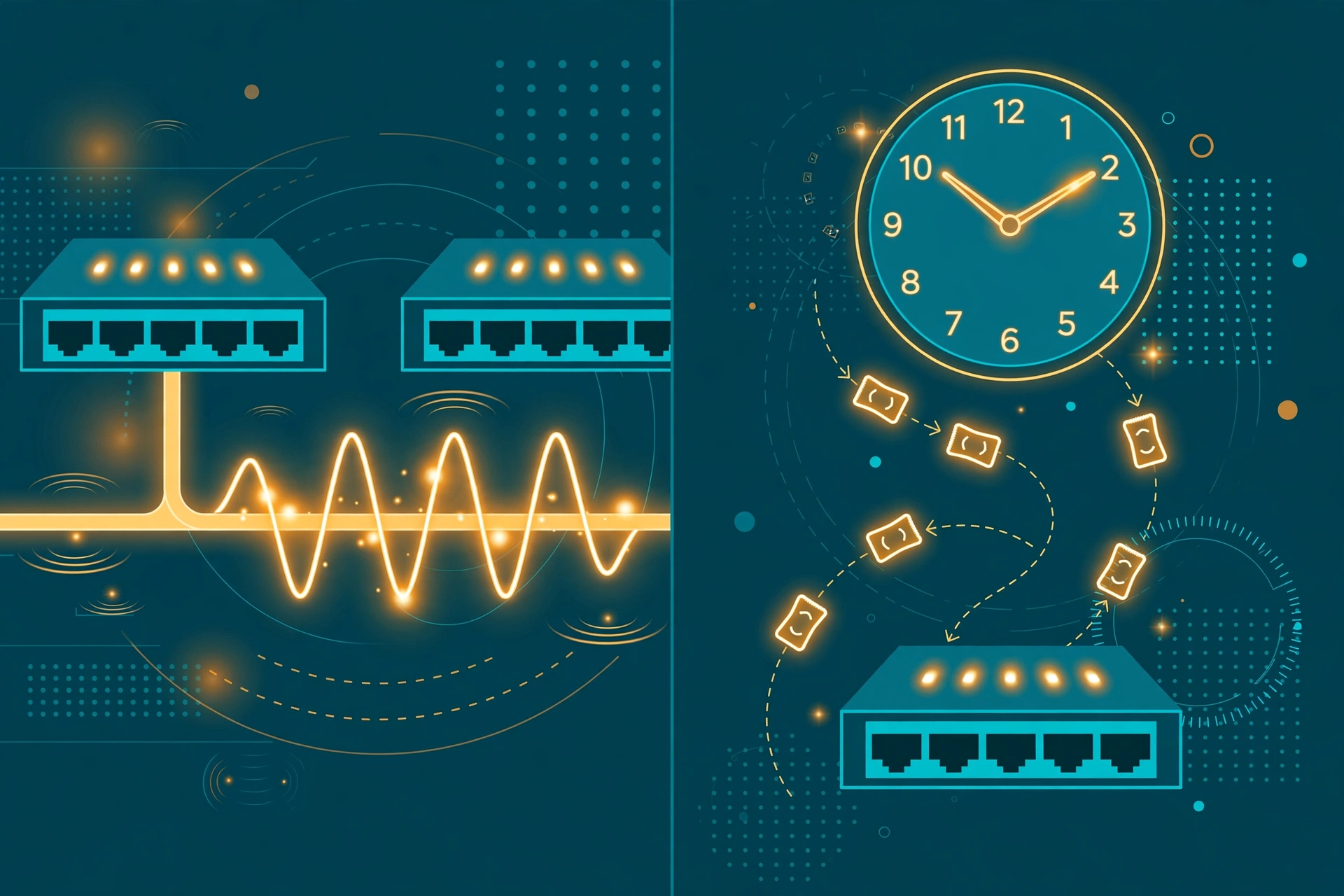
What is the difference between SyncE and PTP? SyncE gives a network one shared tempo. PTP gives it a shared tempo, a shared beat, and a shared clock reading. SyncE (Synchronous Ethernet) recovers a clock's frequency — how fast it ticks — from the Ethernet signal arriving on a cable. No timing packets are sent, so there is nothing for a busy queue to delay. PTP (Precision Time Protocol, IEEE 1588) sends timestamped packets between a grandmaster and its followers, and from those packets a follower can work out frequency, phase (whether its ticks line up with the grandmaster's ticks) and time of day (what its clock should read). The price is that PTP's evidence travels as ordinary packets, and packets do not always take the same time in both directions.
Think of two orchestras again, because timing really does split this way. SyncE is handing every musician the same metronome speed: everyone counts at exactly the same rate, but nobody has said which beat is beat one, and nobody's watch agrees. PTP is a conductor sending both the speed and the downbeat and the time — richer information, delivered by messengers who can be held up in traffic. Hybrid mode, the pairing this article is really about, gives the orchestra the metronome and the conductor: the metronome (SyncE) holds the speed steady so the conductor (PTP) only has to call the downbeat, not constantly correct a tempo that keeps wandering.
The two, side by side
| Question | SyncE | PTP | Hybrid mode (SyncE + PTP) |
|---|---|---|---|
| What does it deliver? | Frequency only | Frequency, phase and time of day | Frequency from SyncE; phase and time of day from PTP |
| How does the timing travel? | In the Ethernet signal itself, at the physical layer — recovered from the incoming bit stream | In timestamped packets exchanged with a grandmaster | Both at once, on the same links |
| Can queues or congestion hurt it? | No — there are no timing packets to queue behind traffic | Yes — uneven packet delay becomes time error unless the design controls it | Much less for frequency, because SyncE holds it; PTP still has to handle phase evidence carefully |
| What must every hop support? | SyncE on every device in the chain — one ordinary device ends traceability there | For best accuracy, a boundary or transparent clock in each device; it can also cross ordinary networks with reduced accuracy | Both, on the chain you want at full accuracy |
| Standards home | ITU-T G.8261 (architecture), G.8262 (equipment clock), G.8264 (ESMC status messages) | IEEE 1588; telecom profiles in ITU-T G.8275.1 and G.8275.2 | Named in the G.8275.1 profile: PTP for phase, SyncE for frequency stability |
| What it cannot do alone | Tell any device what time it is, or align ticks to the same instant | Guarantee its best accuracy over a path it does not control | Fix a chain where a middle device supports neither — the chain is only as strong as that hop |
Read the first row twice — it is the whole comparison. Almost every argument about these two technologies is really an argument about whether the job needs a clock reading, or only a clock rate. If the job needs a reading, SyncE alone was never a candidate, no matter how clean its frequency is. If the job needs only a rate, PTP alone is doing the job the hard way, with packets, when the cable could have carried it for free.
SyncE in one section: the tempo in the cable
Every Ethernet link already ticks. Bits leave a transmitter at a rate set by its clock, and SyncE is the discipline of trusting that tick: the receiver recovers the clock from the incoming bit stream, disciplines its own Ethernet Equipment Clock (the EEC of ITU-T G.8262) to it, and transmits onward at that recovered rate. Hop by hop, one reference tempo crosses the network at link speed, underneath all the traffic. Small status messages on the Ethernet Synchronization Message Channel (ESMC, ITU-T G.8264), sent about once a second, tell each device how good the clock behind each port is — a quality level — so devices can pick the best source, refuse a bad one, and avoid following each other in a circle. The full mechanics, including what breaks the chain, are in the companion guide to SyncE explained. The one fact this comparison needs is the limit: frequency is all it carries. There is no timestamp in a recovered clock, no date, no downbeat — by design.
PTP in one section: the time in the packets
PTP does the opposite trade. A grandmaster and a follower exchange timestamped messages — Sync, Follow_Up, Delay_Req, Delay_Resp in the classic two-step dance — and from the four timestamps the follower computes both how far its clock is offset and how fast it is drifting, then corrects both. That is a complete answer: rate, alignment and reading, from one protocol. The catch lives in the arithmetic's quiet assumption, that the trip took the same time in both directions. When queues, congestion or an asymmetric path break that assumption, the error lands directly in the computed offset. Real designs fight back with hardware timestamping at the port, boundary clocks that end each hop and re-serve clean time, transparent clocks that account for their own delay, and profiles such as G.8275.1 (every device on the path takes part) and G.8275.2 (partial support, over IP). How those nanoseconds add up hop by hop is worked through in PTP timing budget explained. Even with all of that, a PTP-only servo is still estimating a frequency from packet arrivals that jitter — which is exactly the job SyncE does without estimating anything.
Hybrid mode, and one worked example
Hybrid mode simply assigns each technology the job it is best at, on the same chain. SyncE locks every device's frequency to the reference, continuously, at the physical layer. PTP then runs over the top delivering phase and time of day, and its servo — the control loop that steers the local clock — has a far smaller job: the local clock is no longer drifting away between packet arrivals, so PTP corrections are about a remaining offset, not about chasing a moving target. The G.8275.1 telecom profile describes exactly this arrangement, with SyncE as the frequency support under PTP phase synchronization. It is also why telecom clock standards assume a physical-layer frequency reference underneath the packet timing.
A worked example, with the arithmetic shown. Take a small chain: grandmaster, two boundary clocks, and a radio at the edge that needs both a stable frequency and phase alignment. First, the drift problem PTP alone would face. A free-running oscillator that is fast by 2 parts per million gains 2 microseconds every second — that is what parts per million means: 2 millionths of each second. Left alone for a minute it would gain 120 microseconds, so a PTP-only servo must keep measuring and removing that drift from packet arrivals whose timing jitters as traffic loads the links. Now run the same chain in hybrid mode. SyncE disciplines each device's oscillator to the reference tempo as a continuous physical-layer signal, so the 2-parts-per-million drift is removed by the frequency lock itself, not estimated from packets. PTP's remaining job on each hop is the phase and time offset — the difference between where the ticks are and where they should be — which changes slowly once the rate is right. Same chain, same grandmaster, same PTP messages: the difference is which errors each layer is asked to absorb. The numbers in this example are this article's own arithmetic illustration of drift, chosen so the parts-per-million sum can be checked by hand; they are not a measurement of any product.
Hybrid mode has a second, quieter benefit: holdover. If PTP's grandmaster path is lost for a while, a device whose frequency is still locked by SyncE drifts far more slowly than one running on its own oscillator, so the time it holds stays usable for longer while the fault is fixed. Frequency stability is what buys time in every holdover story.
When one alone is enough — the honest cases
SyncE alone is enough when nothing in the job reads a clock: a device that needs a stable frequency reference — the classic case is radio equipment that must hold its carrier and frame timing to a network-wide rate — and never needs to know the time of day or align an instant with a distant peer. Adding PTP there buys information nobody uses, plus a grandmaster estate to run.
PTP alone is enough when the chain cannot run SyncE end to end — across leased or third-party networks, over links whose devices do not support it, or in a data-centre fabric where every hop is PTP-aware and the accuracy target is met with margin by boundary clocks and hardware timestamps alone. Plenty of trading and data-centre designs are PTP-only by necessity or by that margin, and the comparison with NTP, for contexts where microseconds do not matter, is in NTP vs PTP.
Hybrid mode earns its work when phase and time must hold a tight budget over a chain you control — telecom transport and radio access are the textbook case, and any timing fabric where packet load varies enough that a packet-only frequency estimate is the weakest link. The cost is real: every hop must support both, the SyncE source selection and the PTP domain design must agree, and a failure plan has to say which layer is believed when they disagree.
The mistakes to avoid. Saying a network is 'SyncE synchronised' when the application needed time of day — the devices tick together and every timestamp is still wrong. Turning on SyncE on most of a chain and assuming the benefit survives the one ordinary switch in the middle — traceability ends at that hop. Letting PTP and SyncE take their references from different grandmasters with no plan for which wins in a failure. And judging hybrid mode by its licence or config cost alone, without pricing the holdover it buys on the bad day.
Try it yourself
Feel the difference the frequency lock makes in the free PTP and SyncE timing simulator: build a multi-hop chain, add packet noise, and watch how much of the time error is the servo chasing drift — then compare chains hop by hop. When you are ready to price a real chain, add its errors up in the free PTP timing budget calculator: enter each hop's clock class and asymmetry, and see whether the budget you must meet is a frequency problem, a phase problem, or both — that answer is the SyncE, PTP or hybrid decision, made with numbers instead of fashion.
- SyncE (Synchronous Ethernet, ITU-T G.8261/G.8262/G.8264) delivers frequency only: a receiver recovers the transmit clock from the incoming Ethernet bit stream at the physical layer, so the timing cannot be delayed by queues or packet jitter. It delivers no phase alignment and no time of day — a SyncE-only network ticks in step without knowing what time it is.
- PTP (Precision Time Protocol, IEEE 1588) delivers frequency, phase and time of day inside packets. That completeness is its strength and its weakness: the messages that carry the time can themselves be delayed, and uneven delay in the two directions (packet delay variation and asymmetry) becomes time error unless boundary or transparent clocks and careful design hold it down.
- Hybrid mode is the standard pairing, named in the ITU-T G.8275.1 telecom profile: SyncE provides the frequency reference and PTP provides phase and time of day. With the tempo already locked by SyncE, the PTP servo no longer has to chase frequency drift from noisy packet arrivals — it corrects the remaining phase offset, which is a smaller, steadier job.
- Choose by the question you actually need answered: frequency only (for example a radio that needs a stable carrier reference and no clock reading) can be SyncE alone; time of day over a network that cannot run SyncE end to end can be PTP alone; phase and time at telecom or trading accuracy, over a chain you control, is where hybrid mode earns its extra design work.