DWDM vs CWDM Explained: How Many Colours Can One Fibre Carry?
One fibre can carry more than one colour of light at once — that trick is called wavelength-division multiplexing, and it comes in two flavours. CWDM is the coarse, cheap one: up to 18 widely spaced colours, uncooled lasers, short and medium links. DWDM is the dense, expensive one: dozens of tightly packed colours in the one band where optical amplifiers work, so the light can be boosted again and again and travel for hundreds of kilometres. This article puts them side by side in one table, explains why a single number — channel spacing — decides almost everything else, and works two real picks end to end, including a 400ZR data-centre link.
The short answer
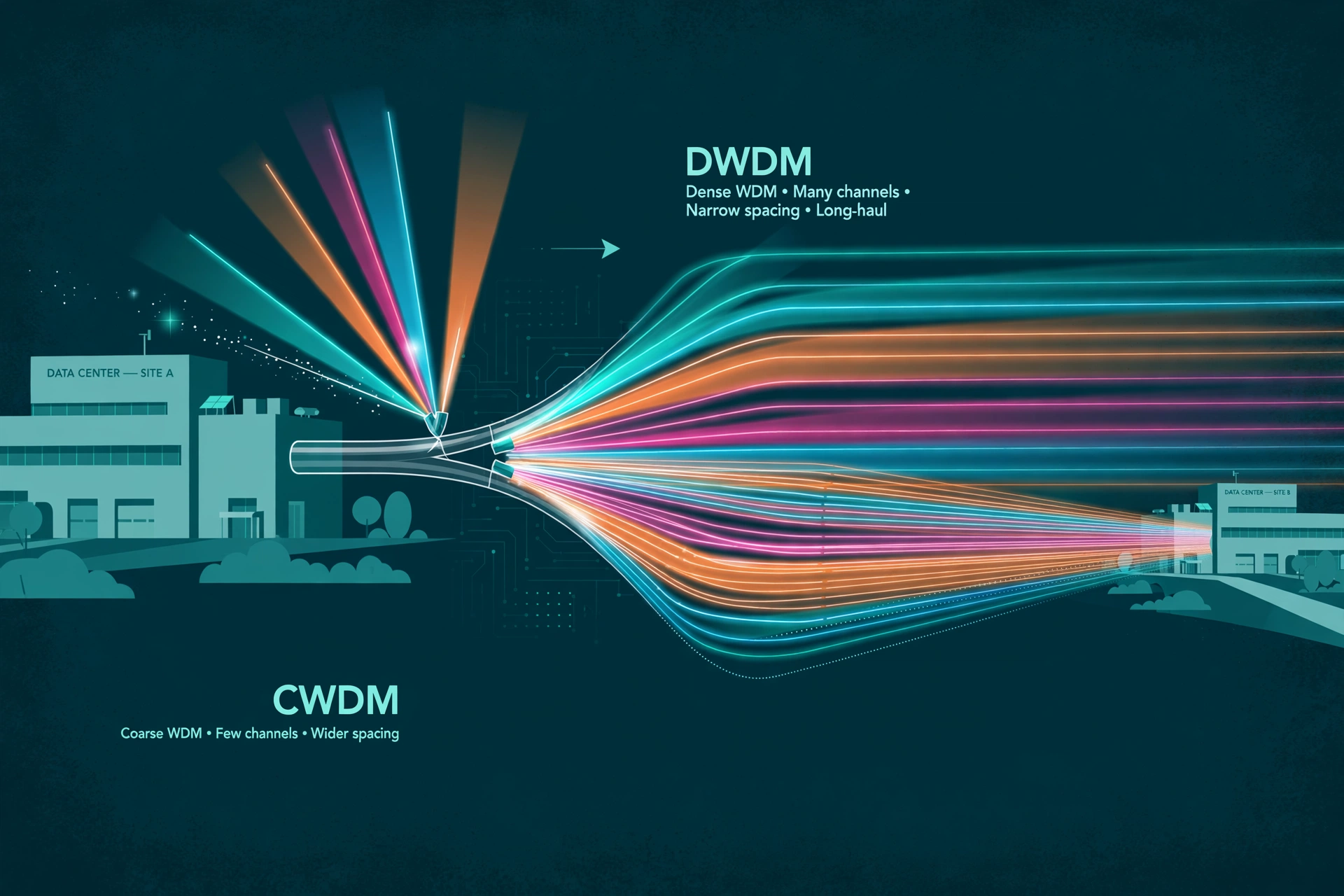
What is the difference between DWDM and CWDM? Both put several colours of light — wavelengths — down one fibre at the same time, each colour carrying its own signal. CWDM (coarse) spaces its colours far apart: 20 nanometres between channels, up to 18 of them across 1271–1611 nm. DWDM (dense) spaces its colours about 25 to 50 times tighter: roughly 0.8 or 0.4 nanometres apart, packed into a narrow band around 1550 nm, fitting 40 to 96 or more channels on one fibre. CWDM is cheaper and simpler and suits short links with modest channel counts. DWDM costs more per channel but scales far higher and, crucially, its colours sit in the band that optical amplifiers can boost — so DWDM is the one that goes hundreds of kilometres.
Think of a fibre as a motorway and each wavelength as a lane. CWDM paints a few very wide lanes: a car can wander a little inside its lane — as we will see, its laser literally wanders with temperature — and never touch the car next door, so the cars can be cheap. DWDM paints dozens of narrow lanes in the most valuable stretch of road: every car must hold its line precisely, which takes expensive steering, but the same road now carries five times the traffic — and this stretch of road is the only one with petrol stations, so only DWDM traffic can refuel and drive across the country.
The two systems, side by side
| Question | CWDM (coarse) | DWDM (dense) |
|---|---|---|
| Standard grid | ITU-T G.694.2 | ITU-T G.694.1 |
| Channel spacing | 20 nm | 100 GHz (about 0.8 nm) or 50 GHz (about 0.4 nm) |
| Where the channels live | 1271–1611 nm, spread across several bands | Mostly the C-band, about 1530–1565 nm; L-band extends it further |
| Channels per fibre | 18 nominal; 8–16 in most real systems | About 40 at 100 GHz; 80–96 at 50 GHz in the C-band; more with C+L bands |
| Laser | Uncooled — allowed to drift inside its wide lane | Cooled and stabilised — must hold a narrow lane precisely |
| Amplification | Not practical for the full grid — most colours sit outside the EDFA band | EDFA (and Raman) amplification is the design centre |
| Typical reach | Unamplified, roughly 40–80 km depending on budget and channel | About 80–120 km per amplified span; hundreds to thousands of kilometres end to end |
| Cost and power per channel | Lower — the budget option | Higher — you pay for precision, amplifiers and reach |
| Home ground | Campus, metro access, fibre-short buildings, a handful of links on one pair | Data-centre interconnect, metro cores, long-haul, coherent 400ZR-class wavelengths |
Read the table as a chain of consequences, not a list of trivia. The spacing row decides the laser row. The wavelength row decides the amplification row. Those two decide the reach and cost rows. Almost every DWDM-versus-CWDM argument in a design review is really an argument about the first two rows.
Why spacing decides the price: the drifting laser
A laser's colour is not perfectly fixed: as its temperature changes, the wavelength it emits drifts. For an uncooled laser across a working temperature range, that drift is several nanometres. Put that laser in a CWDM system and nothing bad happens — its lane is 20 nm wide, so a drift of a few nanometres still leaves it clearly inside its own channel, far from its neighbours. That tolerance is exactly why CWDM optics can skip the cooler, the wavelength locker and the precision electronics, and it is most of why they cost less and draw less power.
Now put the same drifting laser in a DWDM system, where the next channel sits 0.4 nm away. A drift that CWDM would not even notice would smear this channel across several neighbours at once — one wandering car crossing five narrow lanes. So DWDM lasers are temperature-stabilised: a small thermoelectric cooler holds the laser at a set temperature and control electronics keep it on its exact grid frequency. That hardware rides on every single DWDM optic, forever, in purchase price and in watts. Dense packing is never free; you pay for it at every endpoint, which is why density you do not need is money spent for nothing.
Why the band decides the distance: amplifiers only work in one place
Light fades as it travels — as a rough picture, ordinary single-mode fibre absorbs and scatters a fraction of the signal every kilometre, so an unamplified signal eventually falls below what a receiver can read. The fix, on long routes, is to boost the light partway: an EDFA spliced into the line amplifies every channel passing through it at once, no conversion back to electricity needed. It is the petrol station of the motorway picture — and it only exists on one stretch of road. Erbium amplifies in the C-band, roughly 1530–1565 nm.
DWDM was designed around that fact: all of its channels live inside (or, with the L-band, just beside) the amplifier band, so a long DWDM route is a repeating pattern of fibre span, amplifier, fibre span, amplifier — which is how such systems honestly reach hundreds and thousands of kilometres. CWDM's 18 channels spread from 1271 to 1611 nm, so only its two or three highest channels even fall inside the C-band; there is no practical amplifier that boosts the whole CWDM grid together. CWDM links therefore run on the launch power they start with, and their reach is whatever the link budget gives them — typically about 40–80 km, and less on the channels and fibre that lose more light. That is not a flaw in CWDM; it is the trade it made on purpose: give up amplification, get cheap channels for the distances most metro and campus links actually are.
One fibre caveat hides in the CWDM map. Two of its channels, at 1371 and 1391 nm, sit near the so-called water peak — a band around 1383 nm where older fibre absorbs noticeably more light. Modern low-water-peak fibre (G.652.D) largely removes the problem, but on older plant those two channels may be unusable, which is why real CWDM systems often plan on 8–16 channels rather than the full 18. Check the fibre you actually have before counting all 18.
Worked pick one: eight links, 12 kilometres — CWDM wins
The job: two buildings 12 km apart, one spare fibre pair between them, and eight separate 10G services to carry — 80 gigabits in total, no growth plan beyond maybe a few more channels later. Walk both options. CWDM: an 8-channel mux/demux pair, eight uncooled CWDM optics at each end, no amplifiers, no powered anything in between. The distance is far inside the unamplified budget, the channel count fits with room to double later, and every part is the cheap kind. DWDM: it would also work — it would work beautifully — and every optic would carry the cooled, stabilised laser you are not using, on a grid built for ten times your channel count and fifty times your distance. Verdict: CWDM, and it is not close. This is the most common real-world case, and it is the one the cheaper technology was invented for.
Worked pick two: one 400G wavelength, 80 kilometres — DWDM, because 400ZR is DWDM
The job: two data centres 80 km apart need a 400-gigabit link, with more wavelengths expected on the same pair later. The modern way to build that link is 400ZR — and 400ZR is, by definition, a DWDM citizen: one coherent 400G signal on one tunable wavelength on the DWDM grid, in the C-band, designed to ride an amplified line system. CWDM cannot offer this at any price: its grid has no channel for a 400ZR wavelength and its links cannot be amplified. Check the link the way this site's planner checks it: 80 km of standard fibre spends about 1,360 ps/nm of chromatic dispersion against the 400ZR preset's 2,400 ps/nm tolerance — pass; a healthy single amplified span delivers about 29 dB of OSNR against the 26 dB requirement — pass, with the 3 dB margin a sound design wants. Verdict: plain 400ZR on a DWDM line system — and when the second and third wavelengths arrive, they simply join the grid, which is the whole point of building on the dense system. The companion article works this family in full, and the free planner below runs these exact budgets on your own route.
The decision, in four questions
1. How many channels will this fibre ever need to carry? Up to about 16, honestly counted: CWDM is in the game. Dozens, or growth you cannot bound: DWDM.
2. How far, and will the signal need boosting on the way? Comfortably inside an unamplified budget (plan on roughly 40–80 km, and verify the budget): CWDM survives. Beyond that, or any route with amplifier huts in it: DWDM, because only DWDM channels can be amplified together.
3. What rides each channel? Ordinary per-channel rates on simple optics suit both. Coherent high-rate wavelengths — the 400ZR family — are DWDM only.
4. What does a channel cost you, all-in? CWDM's advantage is per-optic price and power. DWDM's is cost per bit once the fibre fills up: 80 channels of capacity on a pair you already own can be far cheaper than leasing or building a second pair for a CWDM system that ran out of colours.
The mistakes to avoid. Buying DWDM for a short, small link because it sounds like the serious option — you pay the precision tax on every optic and gain nothing the link uses. The mirror mistake: speccing CWDM for a route that quietly needs amplification later, then discovering the channels cannot be boosted and the design starts over. Counting all 18 CWDM channels on old fibre without checking the water-peak channels. And assuming CWDM and DWDM optics mix freely because a wavelength looks close on paper — the grids, passbands and channel plans are different systems; hybrid designs exist, but they are engineered, not improvised.
Try it yourself
Take worked pick two and stress it in the free coherent DWDM / 400ZR reach planner: build the 80 km single-span route, confirm the 400ZR verdict, then stretch the route span by span and watch which budget — OSNR, dispersion, or margin — binds first; that moment is the real boundary between one wavelength working and needing a redesign. For the short unamplified links at either end of a design, the free optical link budget calculator does the simpler launch-power-minus-losses arithmetic that decides whether a CWDM channel reaches at all.
- Channel spacing is the whole story in one number: CWDM spaces its channels 20 nm apart across 1271–1611 nm (ITU-T G.694.2, 18 nominal channels); DWDM spaces its channels 100 GHz (about 0.8 nm) or 50 GHz (about 0.4 nm) apart, mostly inside the C-band around 1530–1565 nm (ITU-T G.694.1), fitting roughly 40 channels at 100 GHz and 80–96 at 50 GHz.
- Wide spacing is what makes CWDM cheap: a laser allowed to drift several nanometres with temperature still stays inside its own 20 nm lane, so CWDM optics can use uncooled lasers. DWDM lanes are so narrow that its lasers must be cooled and stabilised — that precision is most of the price difference.
- Amplification is what makes DWDM long: erbium-doped fibre amplifiers (EDFAs) work in the C-band, exactly where DWDM lives, so a DWDM signal can be boosted every span and travel hundreds or thousands of kilometres. Most CWDM colours sit outside that band and cannot be amplified together, so CWDM links are unamplified and typically run up to about 40–80 km.
- Pick by need, not by prestige: a handful of channels over a short or medium link is CWDM's home ground; many channels, any link needing amplification, or coherent high-rate wavelengths such as 400ZR are DWDM's. Buying DWDM for eight short channels pays for precision and reach you never use.