Loop Guard Explained: When BPDUs Go Silent, the Port Stays Shut
Spanning tree keeps one port in every redundant loop blocked, and the blocked port stays blocked only because it keeps hearing BPDUs — hello messages — that prove the other path is alive. If those messages stop arriving, plain spanning tree assumes the other path is gone and opens the blocked port. If the messages stopped because of a one-way link failure rather than a real topology change, that promotion creates the very loop spanning tree exists to prevent. Loop Guard is the rule that refuses the promotion: a root or alternate port that stops receiving BPDUs is held in a loop-inconsistent blocking state, logging %SPANTREE-2-LOOPGUARD_BLOCK, until BPDUs arrive again — and then it heals itself.
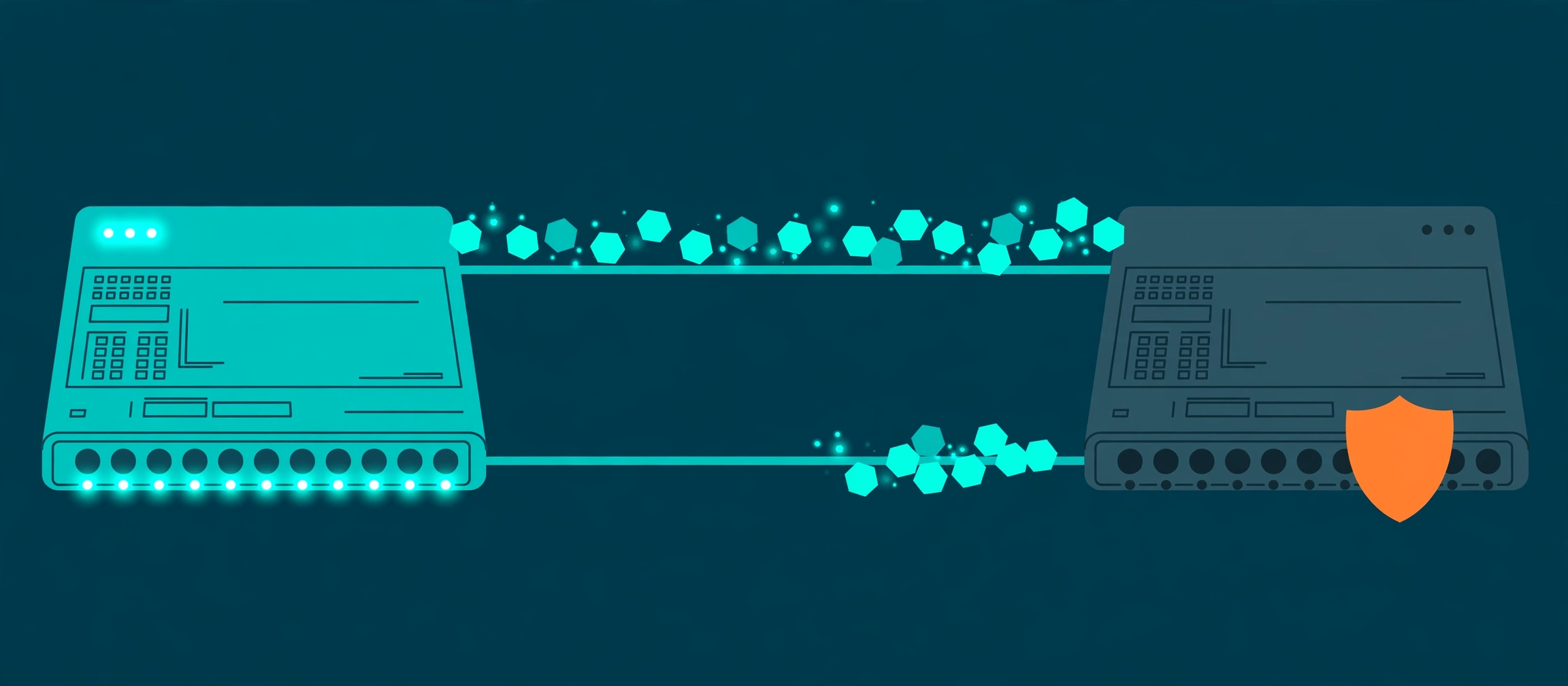
The short answer
What is Loop Guard? It is a spanning-tree safety feature for the ports that listen. A switch port that receives BPDUs (spanning tree's hello messages) on a root or alternate port is being told, every few seconds, "the path toward the root bridge through me is already handled — stay as you are." If those BPDUs stop arriving, ordinary spanning tree eventually concludes the other side is gone, promotes the quiet port, and starts forwarding on it. Loop Guard adds one rule: a port that was receiving BPDUs and stops may not promote itself. It is placed in a loop-inconsistent state — blocked — and the switch logs %SPANTREE-2-LOOPGUARD_BLOCK: Loop guard blocking port GigabitEthernet1/0/49 on VLAN0101. When BPDUs start arriving again, the block lifts by itself.
Picture a night watchman at a warehouse gate that must stay closed while the main gate is open. Every two minutes the main gate radios him: "main gate open, keep yours closed." If the radio goes silent, what should he assume? That the main gate closed — so he should open his? Or that the radio broke — so opening his gate might leave both gates open with no control at all? Plain spanning tree assumes the first: silence means the other path is gone. Loop Guard assumes the second: silence is suspicious, so the gate stays closed until the radio calls again. In a network, "both gates open" is a forwarding loop, and a loop does not degrade a LAN politely — it melts it in seconds. Loop Guard is the watchman's standing order to distrust silence.
The failure Loop Guard exists to stop
Spanning tree's whole design rests on continuous reception of BPDUs. Cisco's Loop Guard document puts it plainly: the designated port transmits BPDUs and the non-designated port receives them, and the blocked port stays blocked because those BPDUs keep arriving. When a port in a redundant topology stops receiving BPDUs, spanning tree conceives that the topology is loop-free — it assumes the sender is gone — so the formerly blocking port takes the designated role and moves, after its timers, into forwarding. If the sender really did die, that is correct failover and the network heals. If the sender is alive and only the BPDUs stopped — a one-way fiber failure, a neighbour whose CPU is too overloaded to send hellos on time, a box in the middle that silently drops spanning-tree frames — then the old path is still forwarding too, and the newly promoted port completes a loop. Every broadcast frame then circulates and multiplies forever, which is the broadcast-storm failure the site's bridging-loop case walks through minute by minute.
Loop Guard breaks exactly that chain of reasoning. With it enabled, a non-designated port that stops receiving BPDUs is moved into the loop-inconsistent blocking state instead of listening, learning and forwarding. The port passes no user traffic, so no loop can form, and the failure is isolated: spanning tree converges around the problem using the paths that still work. The granularity is per-VLAN on a trunk — if BPDUs stop arriving for only one VLAN, only that VLAN is blocked — except on an EtherChannel, where spanning tree sees the whole bundle as one logical port, so the whole channel is blocked for the affected VLAN.
The port's information has gone stale. Whether stale means "the other side died" or "the messages died" is the one question spanning tree cannot answer alone — Loop Guard answers it the safe way.
Three guards, three different moments
Loop Guard is the third member of a trio this site has been building, and confusing them leads to real design mistakes, so here is the cluster in one place. BPDU Guard watches access ports — ports meant for laptops and phones — and acts on a BPDU arriving: something switch-like appeared where no switch belongs, so the port is err-disabled and waits for a human. UDLD watches the physical link itself, sending its own probes to prove the link carries traffic in both directions; it acts per-port, and it catches faults Loop Guard structurally cannot — a link that was unidirectional from the moment it came up never received BPDUs in the first place, so Loop Guard sees a normal designated port, while UDLD sees a one-way link. Loop Guard watches the spanning-tree conversation on switch-to-switch ports and acts on BPDUs going missing: per-VLAN, self-healing, no human needed once the cause is fixed. One more honest difference from Cisco's own comparison table: Loop Guard also protects against a designated switch that stops sending BPDUs because of a software problem — UDLD cannot, because the link itself is perfectly bidirectional; it is only the hellos that stopped. That is why Cisco's conclusion is not either/or: the highest level of protection is UDLD and Loop Guard enabled together, each covering the other's blind spot.
Same family, different senses: BPDU Guard hears something it should not, Loop Guard stops hearing something it should, and UDLD checks the wire itself.
Where it belongs — and where it does not
Loop Guard is configured per port with spanning-tree guard loop, or switched on for all ports at once with the global spanning-tree loopguard default — it is off by default. Cisco's placement rule is the one engineers get subtly wrong: it must be active on the non-designated ports — root and alternate — for every topology the network can converge into, not just the ports that happen to be blocking today. A trunk can be designated for one VLAN and non-designated for another, and a failover can turn today's forwarding root port into tomorrow's alternate. Enabling it globally and pruning exceptions is usually the honest way to meet that rule. The limits matter just as much: it belongs on point-to-point links (full-duplex links are treated as point-to-point); it must not be enabled on shared links, where blocking can cut off hosts; it cannot coexist with Root Guard on the same port — the two guards pull in opposite directions, Root Guard on designated ports refusing to let them become non-designated, Loop Guard on non-designated ports refusing to let them become designated — and configuring Loop Guard on a port disables Root Guard there; and it cannot be enabled on PortFast edge ports, which are BPDU Guard's territory anyway.
Checks, in order, when the log line appears
Step 1 — scope it. Run show spanning-tree inconsistentports. The site's decoder entry for %SPANTREE-2-LOOPGUARD_BLOCK names this as the first check: it lists every port a spanning-tree safety feature is currently holding, so you see whether this is one port on one VLAN or a pattern across a switch — a pattern points at the neighbour or the path, not at one optic.
Step 2 — cross-check the wire for the one-way fault. Run show udld neighbors and show interfaces counters errors on the port (the decoder entry's example is GigabitEthernet1/0/49). Loop Guard and UDLD often catch the same fault from opposite sides: a dead transmit strand, a failing optic, a dirty fiber connector. Physical errors climbing on the interface are the explanation, not a coincidence.
Step 3 — interrogate the neighbour and the middle. Is the switch at the other end alive, converged and sending? Check its CPU and its own spanning-tree state for the VLAN — a neighbour too busy to send BPDUs on time produces exactly this symptom on every port facing it. And walk the path for anything inserted between the switches — a media converter, a small unmanaged switch, a misconfigured bridge — that forwards user traffic but does not pass spanning-tree frames; that device explains a link that passes pings and fails hellos.
The fix — restore the BPDUs, never remove the guard
Fix the physical path: clean or replace the fiber, swap the failing optic, remove or replace the device in the middle that eats BPDUs, or relieve the neighbour that cannot send them. There is no port to clear and nothing to bounce: when BPDUs are received on a loop-inconsistent port, the recovery is automatic — the switch logs %SPANTREE-2-LOOPGUARD_UNBLOCK, removes the loop-inconsistent condition, and spanning tree determines the port's state from the live topology. Confirm with show spanning-tree inconsistentports coming back empty for the port. If the block keeps returning, the BPDUs keep stopping — the cause is intermittent, not fixed, and the returning block is the evidence. And the one move that is never the fix: disabling Loop Guard. The decoder entry says it flatly — never respond by disabling Loop Guard — because an unguarded version of this same fault is a full network loop. Turning off the guard converts a named, blocked, survivable fault into the storm it was holding back. If a design review concludes Loop Guard genuinely does not belong on a specific port — a shared segment, a Root Guard port — that is a planned change with the reason written down, not a 2 a.m. reaction to a log line.
Try it yourself
When the log line is what you have, open the decoder entry for %SPANTREE-2-LOOPGUARD_BLOCK and work its checks in order, then complete the guard trio with UDLD Explained and BPDU Guard and PortFast Explained. To compare two switch configurations side by side and catch a guard enabled on one switch and missing on its neighbour, use the free Network Config Verifier.
Fact-check sources: the failure mechanism (a blocking port that stops receiving BPDUs assumes the topology is loop-free, takes the designated role and forwards, creating a loop), Loop Guard's response (the non-designated port moves to the loop-inconsistent blocking state instead of listening/learning/forwarding; the state passes no user traffic; recovery on BPDU receipt is automatic), the exact log messages %SPANTREE-2-LOOPGUARD_BLOCK and %SPANTREE-2-LOOPGUARD_UNBLOCK, the per-VLAN granularity and the EtherChannel whole-channel consequence, the placement rule (root and alternate ports, for all possible active topologies; a trunk can be designated for one VLAN and non-designated for another), the commands (spanning-tree guard loop per interface; spanning-tree loopguard default globally; off by default), the Loop Guard versus UDLD comparison table (per-VLAN versus per-port granularity; protection against a designated switch's software failure — Loop Guard yes, UDLD no; incorrect wiring — UDLD yes, Loop Guard no; UDLD disabling only the failed member of an EtherChannel while Loop Guard blocks the channel; Loop Guard not working on a link unidirectional since link-up; highest protection from enabling both), and the interoperability limits (mutually exclusive with Root Guard, and configuring Loop Guard disables Root Guard on that port; cannot be enabled on PortFast or dynamic-VLAN ports; must not be enabled on shared links) — Cisco, Understand STP Loop Guard and UDLD Features, and Cisco, Configuring STP Extensions, both opened in full this run. The sample message (%SPANTREE-2-LOOPGUARD_BLOCK: Loop guard blocking port GigabitEthernet1/0/49 on VLAN0101.), its meaning, its causes (a one-way link; an overloaded neighbour; an inserted device that does not pass spanning-tree traffic), its checks (show spanning-tree inconsistentports; show udld neighbors; show interfaces counters errors) and its fix (fix the physical path, confirm BPDUs arriving again, never disable Loop Guard) are quoted from the site's own decoder entry, sourced from Cisco Loop Guard documentation.
Related guides
- Loop Guard watches non-designated ports — root and alternate/backup ports, the ports that receive BPDUs rather than send them. If BPDUs stop arriving on such a port, Loop Guard puts it into the loop-inconsistent state, which blocks traffic like a blocking state, instead of letting it age out its information and promote itself to designated and forwarding.
- The classic trigger is a unidirectional (one-way) link: one direction of a fiber pair fails, so the link looks up but BPDUs flow only one way. Other causes are a neighbour too busy or too broken in software to send BPDUs on time, and a device inserted between the switches that does not pass spanning-tree traffic. The log message is a symptom — the fault is whatever stopped the BPDUs.
- Loop Guard, UDLD and BPDU Guard are three different guards for three different moments: Loop Guard acts when expected BPDUs go missing on switch-to-switch ports (per-VLAN, auto-recovers when BPDUs return); UDLD probes the physical link itself for one-way operation (per-port, and it also catches a link that was one-way from the moment it came up, which Loop Guard cannot); BPDU Guard acts when an unexpected BPDU arrives on an access port meant for end devices, and err-disables it. Cisco's guidance is that the highest protection comes from running Loop Guard and UDLD together.
- The port heals itself and you never clear it by hand: fix whatever stopped the BPDUs — the fiber, the optic, the overloaded neighbour, the BPDU-eating device in the middle — and when BPDUs arrive again the switch logs %SPANTREE-2-LOOPGUARD_UNBLOCK and spanning tree works out the port's proper state on its own. Disabling Loop Guard as a fix removes the guard, not the fault, and re-arms the loop.